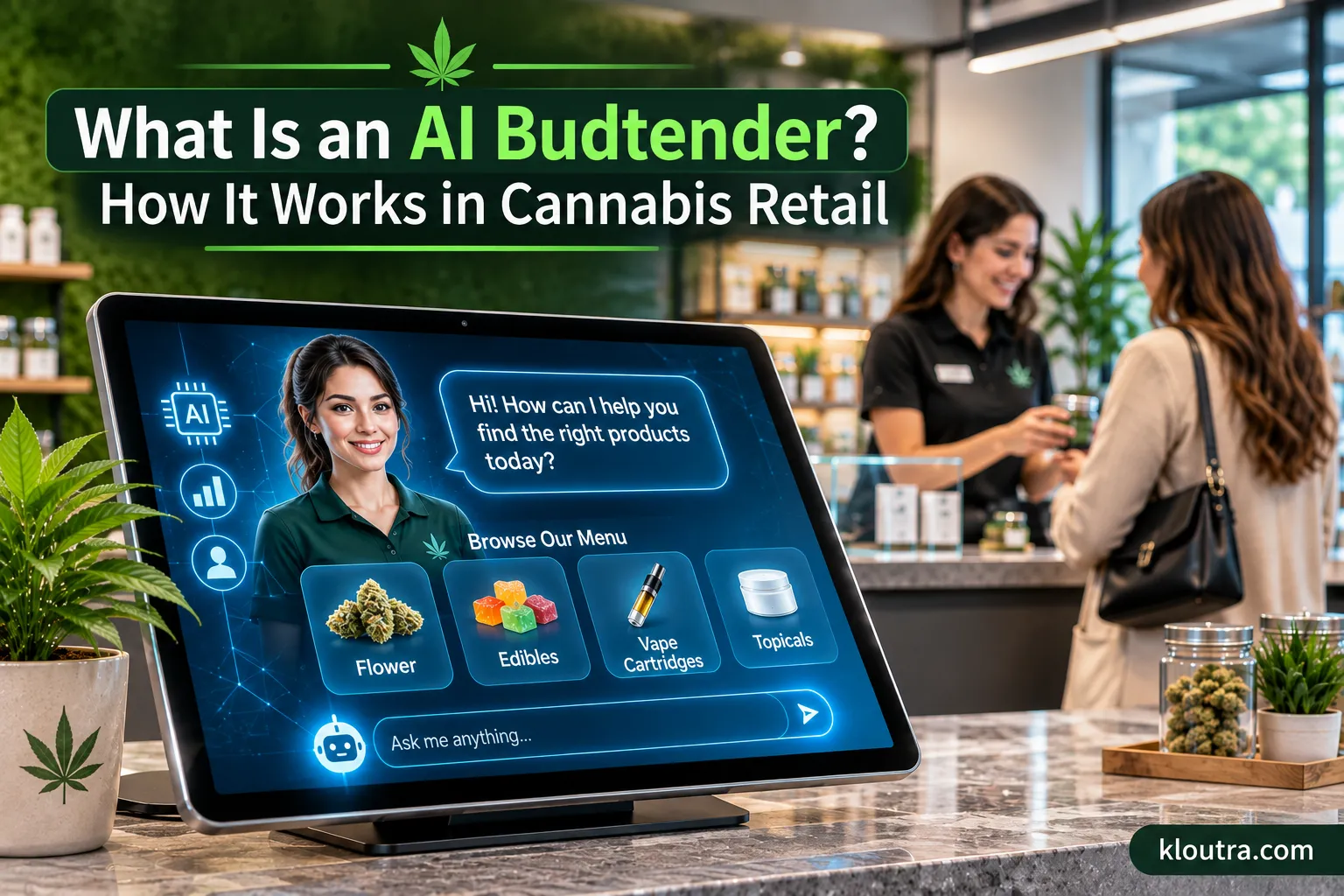
What Is an AI Budtender? How It Works in Cannabis Retail
Cannabis dispensaries offer products like flower, edibles, concentrates and topicals, but choosing between them can be confusing. An AI budtender makes shopping easier by answering customer questions, explaining product details and helping shoppers find suitable options. It can connect with product catalogs, inventory systems and online shopping carts to support dispensary operations.
For US cannabis retailers, this technology can improve customer service and save employees time. However, product accuracy, customer privacy, age verification and state regulations remain important. This guide explains how AI budtenders work, their benefits and what dispensary owners should know before using them.
What Is an AI Budtender?
An AI budtender is a digital assistant that helps customers find and understand cannabis products. It uses artificial intelligence to understand questions and provide answers based on available product information.
For example:
A customer visiting a dispensary website might ask:
- What flower products are available?
- What is the difference between THC and CBD?
- Which edibles are under 10mg THC per piece?
- What products are currently on sale?
The AI assistant can search the store’s product information and provide relevant answers. It can also show matching products when the software supports product recommendations. Unlike a basic chatbot, an AI budtender can understand different ways of asking a question. Customers do not always need to select from fixed buttons or follow a set list of questions.
Dispensaries can use AI budtenders in different ways:
- Online stores: Help customers explore products on dispensary websites.
- Mobile apps: Answer product questions while customers browse on their phones.
- In-store kiosks: Give shoppers another way to search for products.
- Staff tools: Help employees find product information quickly.
How Does an AI Budtender Work?
An AI budtender uses customer questions and store information to provide useful answers. The exact process depends on the software, but most systems follow a similar approach.
1. Understands Customer Questions
First, the customer types a question into the assistant. The AI uses language technology to understand what the person wants to know.
For example:
A customer asks, “Do you have any vape cartridges for less than $40?” The AI understands the product type and price limit, then searches the dispensary’s menu.
2. Searches Product Information
Next, the assistant checks the dispensary’s product catalog or connected database.
This information may include:
- Product names and descriptions
- Product types and sizes
- THC and CBD details
- Available prices
- Current stock
- Product testing and label information
3. Finds Relevant Products
After understanding the question, the AI looks for products that match the customer’s stated preferences.
For example:
A customer looking for gummies under $25 with 5mg THC only sees products that match both requirements. The assistant can narrow the available options and show relevant products from the store’s menu.
4. Gives Answers and Suggestions
The AI then presents its answer in simple language. Depending on the software, it may compare products, explain product details or suggest items to explore. Some systems can also answer questions about store promotions and current deals.
5. Helps Customers Continue Shopping
Some advanced AI budtenders connect directly with online shopping carts. Customers may be able to add products to their carts during the conversation and continue to the store’s normal checkout process.
Example Conversation (For Illustration):
Customer: Do you have any gummies under $25 with 5mg THC?
AI Budtender: Yes, we have three gummy products under $25, each with 5mg THC per piece. Here are their prices and pack sizes. Two are available in this store, while one can be pre-ordered.
Customer: Which one is good for sleep?
AI Budtender: I can’t tell you how a product will affect you. However, I can compare its listed ingredients and cannabinoid content. For personal advice, you can speak with a store employee. Would you like me to connect you?
Main Features of AI Budtender Software
AI budtender software can offer different features depending on the provider. Some tools answer basic questions, while others connect with the dispensary’s online store and inventory.
Here are the main features worth understanding:
Conversational Product Search
Customers can search for products by asking questions instead of using filters. This makes browsing easier when they do not know the exact product name.
For example:
A shopper can ask to see available flower products or compare different product formats. The assistant can then show relevant items from the store’s menu.
Product Recommendations
Some AI budtenders suggest products based on customer preferences.
They may consider details such as:
- Preferred product type
- Price range
- Product size
- Listed THC and CBD information
- Previous shopping preferences, where permitted
These suggestions can help customers explore a large catalog.
Live Inventory Updates
This is an important feature for dispensary owners. When AI software connects with the store’s inventory system, it can check which products are available. This helps prevent customers from seeing items that are no longer in stock. Retailers should check how often inventory updates because outdated information can create problems during shopping.
Promotion and Deal Information
Some AI budtenders can explain store discounts and promotions.
For example:
Customers may ask which products qualify for a current offer or how a discount works. The assistant can use the store’s promotion details to explain the available deal. This can reduce confusion and help customers understand store offers.
Benefits of AI Budtenders for Cannabis Dispensaries
AI budtenders can help cannabis retailers manage common customer questions and make online product searches easier.
Here are the main business benefits:
1. Makes Online Shopping Easier
Large product menus can be difficult to navigate. Customers may need to open several pages before finding the information they want. An AI assistant can narrow the options based on a question. This saves customers time and makes product discovery more direct.
2. Answers Common Questions
Dispensary employees often answer similar questions throughout the day. An AI budtender can handle basic questions about product types, sizes, prices and available options. Employees can then spend more time helping customers who need personal assistance.
3. Supports Customers Outside Store Hours
An online AI assistant can remain available when the physical store is closed. Customers can browse product information and get answers without waiting for an employee to become available.
4. Helps Customers Understand Product Information
Cannabis labels can include terms that some shoppers do not understand. An AI budtender can explain basic information about THC, CBD, product formats and listed ingredients. Clear explanations help customers understand what a product contains before making a shopping decision.
5. Helps Stores Understand Customer Needs
Some AI platforms provide reports about customer questions and product searches. Dispensary owners can review these reports to understand which products customers search for most often and where shoppers need more information.
For example:
Repeated questions about product sizes may show that the store needs clearer product descriptions.
AI Budtender vs. Human Budtender
Human budtenders and AI have different strengths. AI can help with product searches and routine questions, while people provide personal support and human judgment.
| Feature | AI Budtender | Human Budtender |
|---|---|---|
| Availability | Can work online 24/7 | Depends on staff hours |
| Product search | Searches connected catalogs | Uses experience and store knowledge |
| Common questions | Handles routine questions | Answers questions personally |
| Customer interaction | Digital conversation | Face-to-face or personal support |
| Complex situations | May need human help | Better suited to human judgment |
| Personal service | Limited | More flexible |
A dispensary can use AI to handle basic online questions while keeping trained employees available for customers who need more detailed assistance. This combination can make customer service more practical without losing the human side of retail.
Challenges and Risks of AI Budtender Software
AI budtenders can make shopping easier, but dispensary owners should understand their limitations before using them.
Incorrect Product Information
AI can give wrong answers when product descriptions or inventory records are incomplete.
For example:
It may show an unavailable product or provide incorrect details about its ingredients. Retailers should keep product information updated and review the assistant’s answers regularly.
Customer Privacy
Some AI systems may collect customer preferences, chat history or purchase information.
Before choosing a platform, retailers should check:
- What customer information the software collects.
- How long the information is stored.
- Whether data is shared with other companies.
- How customers can request access or deletion.
Customer information should only be collected and used according to applicable privacy laws and the store’s privacy policy.
Where AI Still Has Limitations
AI does not understand every situation like a person. It may misunderstand questions or provide answers that lack important context. Customers should have an easy way to contact a human employee when they need help.
Software and Integration Costs
AI budtender software may need to connect with existing inventory, POS and eCommerce systems. Some platforms also charge setup fees or monthly subscription costs. Retailers should compare these costs with the time and work the software can actually save.
AI Budtenders and US Cannabis Regulations
Cannabis businesses in the United States must follow state-specific rules. Requirements can differ depending on where a dispensary operates. An AI budtender does not remove these legal responsibilities.
Customer information: Dispensaries should review local privacy requirements before using purchase history or personal preferences for AI recommendations. Maryland, for example, requires express permission for creating adult-use consumer profiles using personal information. Library of Maryland Regulations
Product claims: AI-generated answers should not make unsupported medical claims or promise that cannabis products can treat diseases.
Advertising and Age Checks: Many US states have rules about how cannabis businesses communicate with customers. These rules can also apply to AI chatbots. In California, for example, licensed businesses must confirm that a person is 21 or older before starting certain direct conversations. Cannabis ads must also appear where at least 71.6% of the audience is expected to be 21 or older. Other states have different rules. Dispensaries should check their state’s requirements before adding an AI assistant to their website.
Data Privacy in California: California’s privacy law (CCPA) applies to businesses that meet certain requirements. These businesses must explain what customer information they collect and allow customers to request access to or deletion of their data. If an AI budtender saves chat history or customer preferences, that information may also be covered by these rules.
Staff involvement: AI should not replace required employee checks, licensed retail procedures or final sales approval.
How to Choose the Right AI Budtender Software
Not every dispensary needs the same AI features. A small store may only need help with product questions, while a larger retailer may want inventory and shopping cart integration.
Examples of AI Budtender Tools
Several companies now offer AI budtender tools for cannabis dispensaries. StrainBrain provides an AI budtender that can connect with online menus and shopping platforms such as Dutchie, Jane, Weedmaps, BLAZE and Tymber. It can also work on in-store kiosks and tablets. Pluggi offers an AI chat tool that helps customers find products based on their preferences. It has also worked with the Springbig loyalty platform, allowing shoppers to join rewards programs after receiving product suggestions.
Features and integrations may change over time. Dispensaries should check each company’s latest offerings and request a live demo before choosing a tool.
Consider these five points before choosing software:
- Inventory connection: Make sure the software can access current product information and availability.
- Accurate answers: Check whether it uses reliable product descriptions and approved information.
- Privacy controls: Understand how customer information is collected, stored and used.
- Easy integration: Check whether it works with your existing POS and eCommerce systems.
- Pricing and support: Compare setup costs, monthly fees, maintenance and customer support.
Ask the provider for a live demonstration before purchasing. Test it with real product questions and check whether its answers match your dispensary’s information. This is a simple way to find problems before customers start using the system.
The Future of AI Budtenders in Cannabis Retail
AI budtenders are becoming more connected to the shopping process. Newer systems can do more than answer questions. They can help customers explore products, understand promotions and manage shopping carts. Future improvements may include better voice search, more accurate product information and stronger connections with dispensary software.
Final Thoughts
An AI budtender is a digital assistant that helps cannabis customers find products and understand dispensary menus. It can answer common questions, show relevant products and support online shopping. For US dispensaries, this technology can make product searches easier and reduce some routine work for employees. However, it needs accurate store information, proper privacy controls and support from human staff.
Frequently Asked Questions
1. Is an AI Budtender Legal?
There is no specific law for AI budtenders. However, dispensaries must follow their state’s cannabis rules for age checks, advertising, customer privacy and product information. Before using one, check your state’s rules with a qualified compliance expert.
2. How Is an AI Budtender Different From a Regular Chatbot?
A regular chatbot usually gives answers through fixed buttons or prepared messages. An AI budtender can understand questions written in different ways. It uses the dispensary product information to answer questions about prices, sizes, THC details and available products.
3. Can an AI Budtender Recommend Cannabis Products?
Yes. It can suggest products based on customer preferences, such as product type, price and listed THC or CBD content. However, it should explain product details instead of making promises about how a product will affect someone.
4. Can an AI Budtender Give Medical Advice?
No. An AI budtender should not diagnose health problems or claim that cannabis products can treat illnesses. Customers who need personal advice should speak with a qualified professional or store employee.
5. What Happens If an AI Budtender Gives Wrong Product Information?
This can happen when product details or stock information are outdated or incomplete. Dispensaries should update their product records regularly and check the AI answers to avoid giving customers incorrect information.
6. Do AI Budtenders Need Age Verification?
Yes, when state or local laws require it. For example, California requires age confirmation before certain direct marketing conversations. An AI chatbot does not replace the ID and age checks required when customers buy, collect or receive cannabis products.
7. How Much Does an AI Budtender Cost?
The price depends on the provider, features and software connections. Some companies charge a setup fee and a monthly subscription. Extra costs may apply when connecting the AI tool to an existing POS system or online menu. Ask providers for current prices and request a live demo before choosing one.
Disclaimer: This article is for informational purposes only. Cannabis laws vary by state. Businesses should check local regulations before using AI retail tools.