AI Consultant vs AI Agency: Which One Is Better for Your Business
Artificial intelligence is changing how businesses work. Companies now use AI to answer customer questions, automate daily tasks, analyze data and improve marketing. But choosing the right help can be confusing. Some businesses hire an AI consultant, while others work with an AI agency. Both offer AI-related services, but their roles are not always the same.
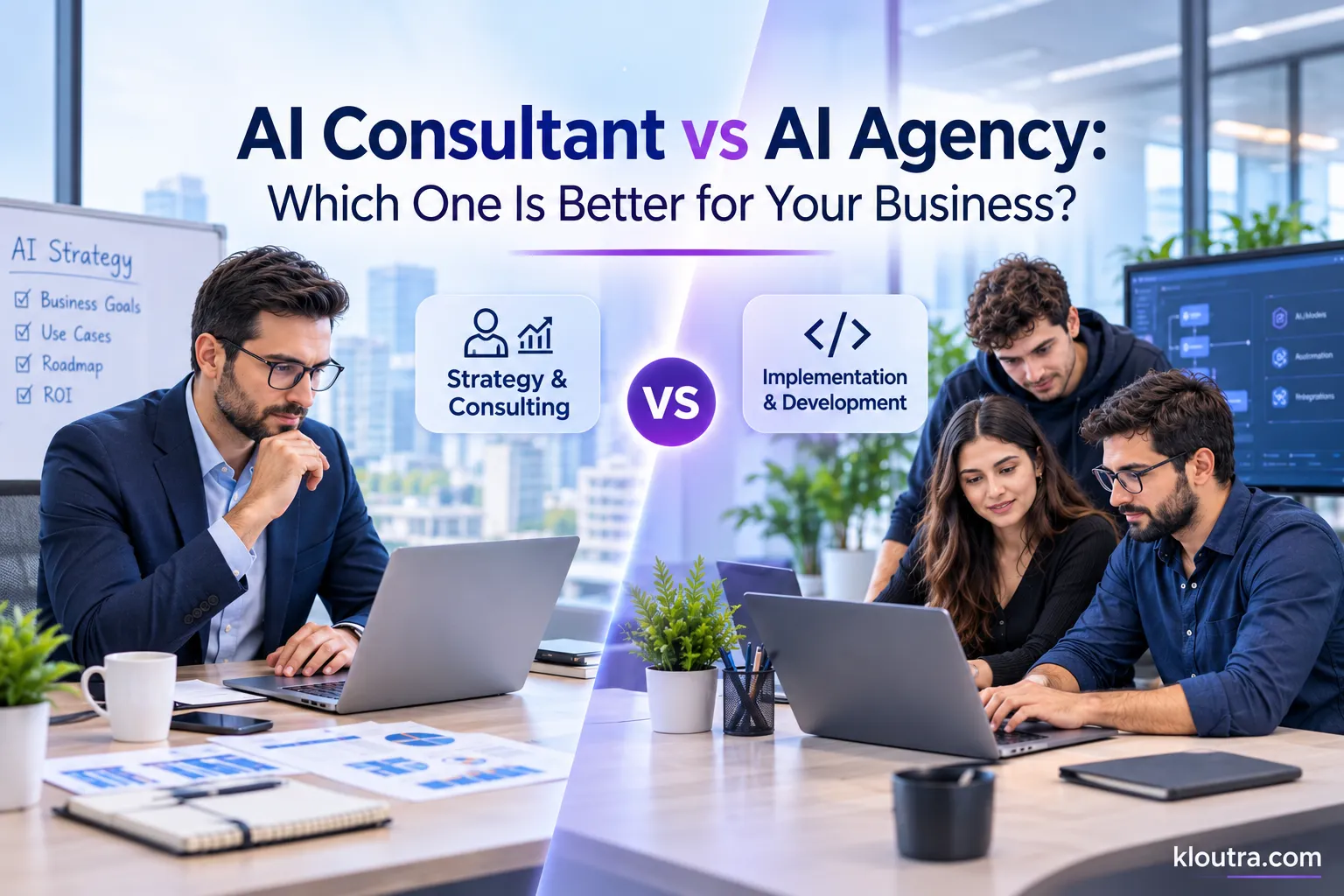
An AI consultant usually helps you understand what your business needs and how AI can help. An AI agency often has a team that builds and delivers AI solutions. So, which one should you choose? The answer depends on your business goals, budget and the type of support you need.
What Is an AI Consultant?
An AI consultant is a professional who helps businesses understand and use artificial intelligence. They study how a company works, identify problems and recommend ways to use AI.
For example: A small online store may spend hours answering customer questions. An AI consultant can review its support process and suggest whether an AI chatbot or automated system would help.
An AI consultant may provide services such as:
- AI strategy: Creating a plan for using AI in a business.
- Business assessment: Finding tasks that could benefit from AI.
- Tool selection: Helping companies choose suitable AI software.
- Workflow advice: Showing where automation can save time.
- Staff training: Teaching employees how to use AI tools.
- Risk assessment: Identifying privacy, security and accuracy concerns.
What Is an AI Agency?
An AI agency is a company that provides AI-related services through a team of professionals. Depending on its services, the team may include AI developers, automation specialists, software engineers, designers and project managers.
For example: A business may want to automate customer support. An AI agency can build a chatbot, connect it to the company’s website, test its responses and help launch it.
Common AI agency services include:
- AI chatbot development: Building chatbots for websites and customer support.
- Workflow automation: Automating repeated business tasks.
- AI agent development: Creating systems that complete defined tasks using connected tools.
- AI integration: Connecting AI tools with existing business software.
- Custom AI solutions: Developing software for specific business needs.
- Ongoing support: Fixing issues and improving systems when included in the agreement.
Not every AI agency offers all these services. Some focus on marketing automation, while others specialize in software development, chatbots or business process automation.
AI Consultant vs AI Agency: Key Differences
The main difference is the type of help you need.
| Factor | AI Consultant | AI Agency |
|---|---|---|
| Main role | Provides advice and direction | Builds and delivers AI solutions |
| Team | Often one expert or a small team | Usually a team of specialists |
| Main focus | Strategy and planning | Development and implementation |
| Services | Assessments, roadmaps, tool selection | Chatbots, automation, integrations |
| Best for | Businesses that need guidance | Businesses that need solutions built |
| Support | Depends on the agreement | May include technical support |
| Payment | Hourly, daily or project-based | Project fees or monthly retainers |
These are common differences, not fixed rules. Some consultants also build AI systems and some agencies provide strategy before starting development.
Cost Comparison: AI Consultant vs AI Agency
Cost is another important factor when choosing between an AI consultant and an AI agency. An AI consultant may charge by the hour, day or project. An AI agency may charge a project fee or monthly retainer. Its price can depend on the number of specialists involved, development work, software integrations, testing and ongoing support.
What Do AI Consultants and AI Agencies Usually Charge?
Prices vary widely, so treat these as ballpark figures rather than quotes. Rates also depend on the country, the experience of the person or team and how much technical work is involved.
| Type of help | Typical price range |
|---|---|
| Independent AI consultant | About $100 to $350 per hour |
| Fixed-fee assessment or AI roadmap | Roughly $5,000 to $25,000 |
| Small chatbot or automation project | A few thousand dollars up to $15,000 or more |
| Custom AI build with software integrations | Often $50,000 and above |
| Monthly retainer for ongoing work | Around $2,000 to $30,000, depending on scope |
| Offshore freelancers and teams | Often $25 to $75 per hour |
A lower hourly rate does not always mean a cheaper project. A consultant who charges $250 an hour for 20 hours costs about $5,000. A six-month build with a larger team at the same rate can cost far more. Always compare the total scope, not just the rate.
Before hiring either option, ask for:
- A clear project scope.
- A written price breakdown.
- Details of what is included.
- Any extra software or maintenance costs.
Do not choose based on the lowest price alone. Focus on the work you will receive and the value it can bring to your business.
Pros and Cons of Hiring an AI Consultant
An AI consultant can be a good choice when your business needs expert guidance before spending money on new technology.
Advantages:
- Helps you understand where AI can make a real difference.
- Can prevent spending money on unsuitable tools.
- Offers advice based on your business needs.
- Helps create a clear AI adoption plan.
- Can guide your team through important decisions.
Disadvantages:
- You may need to hire developers separately.
- Advice alone will not solve a problem without proper execution.
- A consultant may have limited availability compared with a larger team.
Pros and Cons of Hiring an AI Agency
An AI agency can help when you already understand your business problem and need a team to build a solution.
Advantages:
- Gives you access to different technical skills.
- Can handle development and implementation.
- May offer testing and ongoing support.
- Can manage larger projects that need several specialists.
- Saves your business from hiring a full internal development team.
Disadvantages:
- A larger project may require a higher budget.
- You may have to manage communication between several team members.
- Some agencies offer services your business does not actually need.
- Support after launch may cost extra.
- A poorly planned project can deliver a solution that does not fix the real problem.
Before hiring an agency, make sure it understands your business process and can explain how its proposed solution will work.
Which One Do You Need? Examples by Industry
| Industry | Start with a consultant if… | Hire an agency when… |
|---|---|---|
| Online store | You are unsure whether to automate support, product descriptions or stock planning | You want a chatbot connected to your order system |
| Real estate agency | You want to find where leads are being lost or followed up too slowly | You need an enquiry chatbot or automatic CRM follow-ups |
| Law firm or accounting practice | You need to understand privacy risks around confidential client files | You need a secure tool built and tested |
| Marketing team | Your content process is messy and you are unsure which steps to automate | You need a repeatable workflow built into your existing tools |
Businesses that handle sensitive data should be more careful. In those cases, a short consulting project on privacy and risk usually comes before development.
How to Choose the Right AI Service for Your Business
Use these steps before making a decision:
1. Identify your main problem
Start by finding the task or process you want to improve. Do not hire someone just because they offer AI services. Look for a solution to a real business problem.
2. Check their experience
Ask for examples of similar projects. Check whether they have worked with businesses in your industry and understand the tools your company uses.
3. Understand what they will deliver
Make sure you know who will handle development, testing and support.
4. Discuss data security
AI projects may involve customer details, company documents or other sensitive information. Ask how your data will be stored, accessed and protected. Also check whether the proposed tools meet your business and legal requirements.
5. Check ownership and ongoing support
Make sure your agreement explains who owns the code, accounts, data and other project materials. Confirm what happens if the system stops working or needs updates after the project is complete.
8 Questions to Ask Before You Hire
A good call with a consultant or agency should answer these:
- Can you show a similar project and what changed afterward? Results matter more than a list of services.
- Who will actually do the work? Make sure it is the people you meet in the sales call, not a different team.
- What do you need from us? This includes data, system access and staff time.
- How will we measure success? Agree on one or two clear numbers, such as tickets handled or hours saved.
- What happens when the AI gives a wrong answer? Ask how errors are caught and who fixes them.
- Which tools and AI models will you use and who pays for them? Software and usage fees often come on top of the project price.
- Can we start with a small pilot? A small first project lowers your risk before a bigger commitment.
- What will a typical month cost after launch? Include hosting, tool subscriptions and support.
Can an AI Consultant and an AI Agency Work Together?
Yes. Some businesses benefit from hiring both. An AI consultant can first review the business, identify opportunities and prepare a practical plan. An AI agency can then use that plan to build and launch the required solutions.
For example: A company may hire a consultant to find ways to reduce manual work in its sales department. After reviewing the process, the consultant may recommend an AI-powered lead management system. The company can then hire an AI agency to build and connect that system with its existing software. This approach can reduce confusion because the business has a clear plan before development begins.
Example: How the Two Roles Fit Together
Imagine an online furniture store whose three-person support team spends most of the day answering the same questions about delivery dates and returns.
Step 1: Consultant (about two weeks). The consultant reviews a month of support tickets and finds that most are simple order-status and return-policy questions. Their report recommends an AI assistant for those two topics only, with a handoff to a human for complaints and damaged items. It also lists the data the assistant will need and the risks to check.
Step 2: Agency (about six to eight weeks). Using that report as a brief, the agency builds the assistant, connects it to the store’s order system, tests it on real past questions and launches it.
Step 3: Review. After launch, the owner checks how many questions the assistant handled and how many were passed to staff, then decides what to improve.
The numbers here are for illustration only, but the pattern is common: the consultant keeps the project focused and the agency builds what was planned.
Frequently Asked Questions
1. What is the main difference between an AI consultant and an AI agency?
An AI consultant mainly helps businesses plan their AI strategy, choose tools and identify opportunities. An AI agency usually has a team that builds, integrates and delivers AI solutions.
2. Is an AI consultant cheaper than an AI agency?
Not always, but a focused consulting project may cost less than a large development project.
3. Can an AI consultant build AI tools?
Yes. Some AI consultants have technical skills and can build or implement AI solutions. Others focus on strategy and advice. Always confirm what is included before hiring.
4. Do small businesses need an AI agency?
Not every small business needs an AI agency. A company with a simple requirement may be able to use an existing AI tool. An agency becomes useful when the business needs custom development, integrations or technical support.
5. Can one company provide both AI consulting and agency services?
Yes. Some companies offer strategy, development, integration and ongoing support. Check their team, previous work and project terms before choosing them.
Final Thoughts
Choosing an AI service is an important business decision. Before making a commitment, take time to understand your requirements, compare providers and set realistic expectations.
A good working relationship should include clear communication, practical goals and measurable results. Avoid paying for complex technology when a simpler solution can meet your needs. Start with a small, well-defined project whenever possible. This gives your business a chance to evaluate the results before making a larger investment.
Disclaimer: This article is for informational and educational purposes only. AI consulting fees, agency pricing and service offerings are estimates and may vary by provider, location and project requirements. Always review a provider’s experience, contract and terms before making a business decision. Kloutra does not guarantee specific results from hiring an AI consultant or agency.