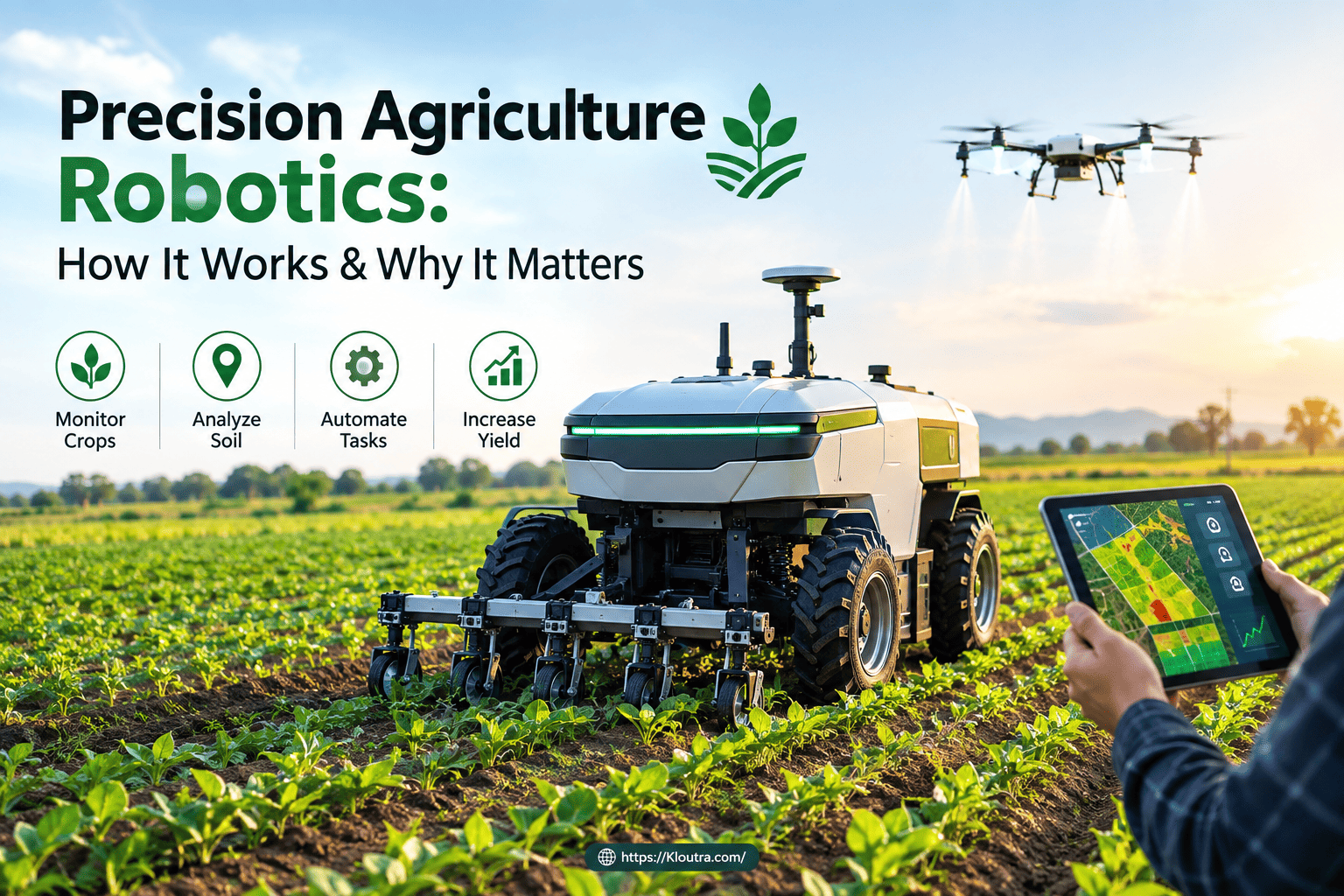
Precision Agriculture Robotics – How It Works & Why It Matters
Introduction
Imagine a machine that can tell a weed from a lettuce plant, then pull only the weed — without touching a single crop. That is precision agriculture robotics in action, and it is no longer science fiction.
Farms today face a hard problem. Labor is harder to find, water is scarcer, and food demand keeps rising. Precision agriculture robotics offers a practical answer by combining robots, sensors, and artificial intelligence to help farmers grow more food with fewer resources.
In this article, you will learn how these systems work, where they are already being used, and why they matter for the future of food production. Agencies like USDA’s National Institute of Food and Agriculture are now funding research into this exact field, which shows how seriously the topic is being taken.
What Is Precision Agriculture Robotics?
Precision agriculture robotics is the use of robots, sensors, and smart software to carry out farm tasks with accuracy and minimal human effort. Unlike a regular tractor that just plows a field, these machines can see, think, and adapt.
In simple terms, they combine three things: robotics (the physical machine), artificial intelligence (the “brain” that makes decisions), and precision farming data (the “eyes” that guide every action).
How This Differs From Regular Farm Machinery
A normal tractor does the same job over and over, no matter what the field looks like. Agricultural robots, on the other hand, adjust in real time.
For example, a robotic sprayer can identify a diseased plant and apply treatment only to that spot, instead of spraying the whole field. This is the core idea behind precision farming technology — doing the right thing, in the right place, at the right time.
How Precision Agriculture Robotics Works
Understanding how these systems function helps explain why they are so useful. Most agricultural robots rely on a mix of hardware and software working together.
Sensors and Machine Vision
Robots use cameras and sensors to “see” the field. These can be regular cameras, or more advanced multispectral and thermal sensors that detect things the human eye cannot, like plant stress or moisture levels.
This is similar to how a doctor uses an X-ray to see beyond the surface. The robot’s sensors let it look past what is visible and understand the real condition of the crop.
Artificial Intelligence and Data Processing
Once the sensors collect data, AI in agriculture steps in to make sense of it. Machine learning models are trained to recognize patterns — for instance, telling a ripe tomato from an unripe one, or spotting early signs of pest damage.
This is what makes the system “smart.” Instead of following a fixed program, the robot learns from data and adjusts its actions.
GPS and Autonomous Navigation
Most autonomous farming robots use GPS systems accurate to a few centimeters. This allows them to move through rows of crops without damaging plants, even without a human driver.
Some machines also use LiDAR (a laser-based sensor) to detect obstacles, similar to the technology used in self-driving cars.
Robotic Arms and Tools
For tasks like harvesting, robots use specialized arms called end effectors. These are designed to handle delicate crops, such as strawberries or apples, without bruising them.
Soft grippers, suction tools, and precision cutters are common examples. Engineers are still working to match the gentleness of a human hand.
Key Applications of Robotics in Agriculture
Agriculture robotics applications now span nearly every stage of farming, from planting to harvest.
Precision Weeding and Spraying
Robotic weeders use cameras to tell weeds apart from crops. Once identified, the weed can be removed mechanically or treated with a tiny, targeted dose of herbicide.
This reduces overall chemical use significantly, since the robot avoids spraying the entire field. It is one of the clearest benefits of agricultural robots in terms of both cost and environmental impact.
Robotic Harvesting
Harvesting is one of the most labor-intensive parts of farming. Robotic harvesters are now being tested and used for crops like strawberries, apples, and tomatoes.
These machines use vision systems to check ripeness before picking, which helps reduce waste and improve fruit quality.
Autonomous Tractors and Field Machinery
Several major manufacturers now offer autonomous tractors that can plow, seed, and haul without a driver in the cab. These machines use cameras, GPS, and AI together to work safely in open fields.
Farm automation like this lets one person manage tasks that used to require several workers.
Drone-Based Crop Monitoring
Drones equipped with special cameras fly over fields to check crop health, detect disease early, and estimate yields. They can also assist with targeted spraying and even seeding in some cases.
This gives farmers a bird’s-eye view of problems that are hard to spot from the ground.
Livestock and Dairy Robotics
Precision agriculture robotics is not only about crops. Robotic milking machines and automated feeding systems are widely used in dairy farming today, reducing manual labor and allowing more consistent care schedules for animals.
Advantages and Disadvantages of Agricultural Robots
Before going deeper into specific benefits and challenges, here is a quick side-by-side view. This is the kind of honest comparison every farmer or student should see before assuming robotics is a perfect solution.
| Advantages | Disadvantages |
|---|---|
| Reduces dependence on manual labor | High upfront purchase and setup cost |
| Applies water, fertilizer, and pesticide more precisely | Struggles with dust, glare, and uneven terrain |
| Works longer hours without fatigue or errors | Usually built for one crop or task, not all farms |
| Can lower chemical use and support sustainability | Needs reliable internet and technical training |
| May improve long-term yield consistency | Repairs and parts can be hard to source in rural areas |
The rest of this article breaks down these points in more detail, starting with the benefits.
Benefits of Agricultural Robots
The growing interest in smart farming technology comes down to a few clear advantages.
Addressing Labor Shortages
Farm work is physically demanding, and fewer people are choosing this career path in many regions. Robots help fill this gap, especially during busy harvest seasons.
Reducing Chemical and Water Use
Because these systems apply water, fertilizer, or pesticide only where needed, they cut down on waste. This supports both cost savings and better environmental outcomes.
Improving Accuracy and Yield
Robots do not get tired or make careless mistakes. Over time, this consistency can lead to healthier crops and, in many cases, better yields.
Long-Term Cost Savings
The upfront cost of agricultural automation can be high. However, many farms report lower labor and input costs over several years, which can offset the initial investment.
Supporting Sustainability Goals
Precision farming robots help reduce a farm’s environmental footprint by lowering chemical runoff, improving soil health through reduced compaction, and cutting unnecessary resource use.
Challenges Facing Robotic Farming Technology
It is worth being honest about the hurdles, too. Precision agriculture robotics is promising, but it is not a simple fix. Even the USDA’s Agricultural Research Service notes that field variability and equipment costs remain real obstacles to wider adoption.
High Upfront Costs
Advanced robots are expensive to buy and maintain. This can make them harder to access for small and mid-sized farms, especially in developing regions.
Unpredictable Field Conditions
Dust, uneven light, rain, and rough terrain can all affect a robot’s sensors. Unlike a factory floor, farms are messy and constantly changing environments.
Limited Crop Flexibility
Many robots are built for one specific crop or task. Adapting a machine to work across different crops and farm layouts is still a work in progress for the industry.
Connectivity and Technical Knowledge
Some smart agriculture tools depend on reliable internet access, which is not always available in rural areas. Farmers may also need training to operate and maintain these systems properly.
The Future of Agricultural Robotics
Interest and investment in this space continue to grow, and researchers are actively working on the next generation of tools.
Swarm Robotics
Instead of one large, expensive machine, some researchers are developing fleets of smaller, cheaper robots that work together across a field. This approach may lower costs and make automation more accessible.
Better AI Decision-Making
Future systems aim to explain their decisions more clearly, helping farmers trust and verify what the AI is recommending — an idea sometimes called explainable AI. If you want a broader look at how AI is being applied across industries, Kloutra’s Artificial Intelligence section covers related tools and trends.
Robot-as-a-Service Models
Rather than buying expensive equipment outright, some companies now offer robots on a subscription or rental basis. This could make automated agriculture more affordable for smaller operations.
Note that this field is evolving quickly, so specific products, companies, and costs may change over time. It is worth checking current sources before making purchasing decisions.
Frequently Asked Questions
What is precision agriculture robotics used for?
It is used for tasks like weeding, spraying, harvesting, planting, and crop monitoring. It helps farmers apply resources like water and fertilizer more accurately, which saves money and reduces waste.
Are agricultural robots only for large farms?
Large farms have adopted these tools faster because of cost, but smaller and modular robotic systems are becoming more available. Rental and subscription models are also making automation more accessible to smaller operations.
How does AI help in agriculture robotics?
AI helps robots recognize patterns, such as identifying weeds, checking fruit ripeness, or predicting disease. This allows the machine to make real-time decisions instead of following a fixed set of instructions.
Do agricultural robots replace farm workers completely?
Not entirely. Robots take over repetitive or physically demanding tasks, but farms still need skilled people for maintenance, oversight, and decisions that require human judgment.
Is precision agriculture robotics good for the environment?
Yes, in most cases. By targeting exactly where water, fertilizer, or pesticide is needed, these systems generally reduce waste and lower a farm’s overall environmental impact.
Conclusion
Precision agriculture robotics is changing how food gets grown, from smarter weeding to gentler robotic harvesting. It brings clear benefits — less waste, lower labor strain, and better use of resources — while still facing real challenges like cost and unpredictable field conditions.
As the technology matures, it is likely to become a normal part of farming rather than a rare exception. If you work in agriculture or are simply curious about where farming is headed, keeping an eye on this space is a smart move. For more guides on how automation and AI are reshaping different industries, browse Kloutra’s Technology section.
Disclaimer: This article is for general informational purposes only and is not professional, financial, or purchasing advice. Product names, costs, and technologies mentioned may change over time — always verify current details before making decisions.