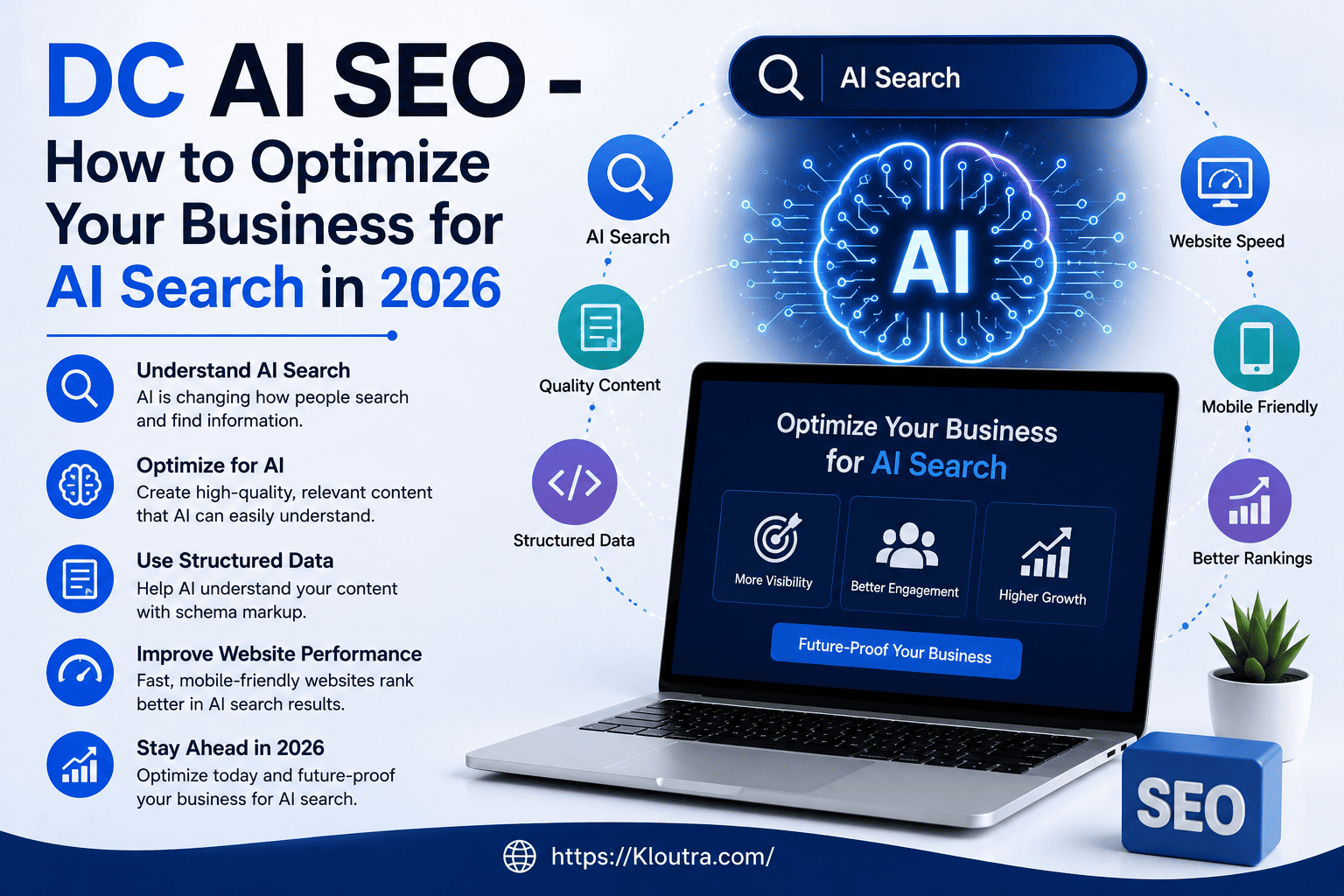
DC AI SEO – How to Optimize Your Business for AI Search in 2026
The way people search for local businesses is changing, making DC AI SEO an important topic for businesses in Washington, D.C. Instead of relying only on traditional Google searches, people are increasingly using AI assistants, voice search, and conversational tools to find services and get quick answers.
For a local business, this shift means that having a website is no longer enough. Your content also needs to be easy for AI-powered search systems to understand. Tools such as Google AI Overviews, ChatGPT, and other AI search platforms can influence how potential customers discover local businesses.
This guide explains DC AI SEO, how AI-powered search works, and practical ways to improve your business’s visibility. You’ll learn how to create useful content, strengthen local SEO signals, and make your website easier for AI systems to understand and reference.
What Is AI SEO?
AI SEO is the practice of optimizing your website and content so that AI-powered search tools can find, understand, and recommend it. This includes Google’s AI Overviews, AI Mode, and chatbots like ChatGPT, Gemini, and Perplexity.
Traditional SEO focused on ranking your page in a list of links. AI SEO focuses on something different: becoming the source an AI system actually pulls its answer from.
Think of it this way. Old SEO was like trying to be the loudest voice in a crowded room. AI search optimization is more like being the one person the room’s translator trusts enough to quote directly.
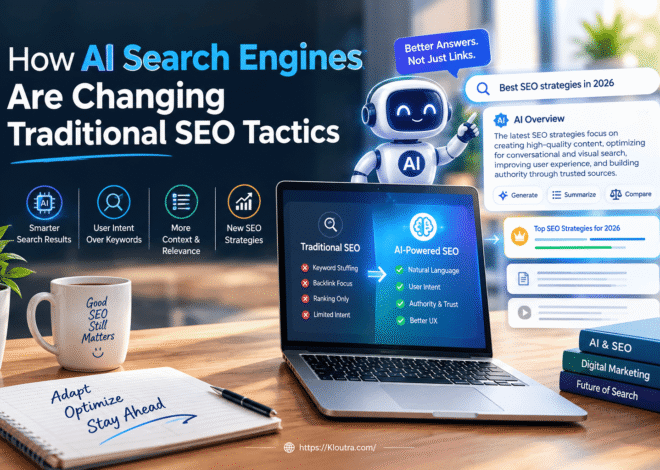
AI SEO vs. Traditional SEO
Traditional SEO still matters — it’s the foundation everything else builds on. Good site structure, quality backlinks, and solid keyword targeting haven’t gone away.
However, AI search optimization adds a new layer on top. It’s less about matching exact keywords and more about answering real questions clearly, so an AI model can lift your answer and use it in a summary or chat response.
AI SEO vs. AEO vs. GEO
You’ll often see three terms used together: AI SEO, AEO (Answer Engine Optimization), and GEO (Generative Engine Optimization).
- AEO focuses on winning featured snippets, voice search answers, and the top spot in an AI Overview.
- GEO focuses on getting cited by name inside chatbot conversations like ChatGPT or Perplexity, where there’s no traditional search results page at all.
- AI SEO is the umbrella term that covers both, plus using AI tools yourself to speed up your SEO work.
Most businesses need a mix of all three, not just one. For a broader look at how AI is reshaping marketing tactics in general, check out Kloutra’s AI for Marketing category.
How AI Search Actually Works
AI search tools don’t crawl and rank pages the exact same way traditional search engines do. Instead, they read large amounts of content, break it into pieces, and try to match the clearest, most trustworthy answer to a person’s question.
Google merged its AI Overviews and AI Mode features into one connected experience in early 2026. This means a search doesn’t just show a short AI summary anymore — tapping into it can lead straight into a longer, back-and-forth AI conversation.
Google has also said publicly that there’s no secret checklist required just to appear in its AI features. According to Google’s own AI Features and Your Website documentation, there are no additional technical requirements beyond standard Search eligibility. In other words, ranking well in AI search still depends on the same basics that make a page rank well in regular search: clear writing, useful content, and trustworthy sources.
AI Search Engine Optimization and Content Quality
AI models are trained to spot vague or thin content. If your page rambles without answering the actual question, it’s less likely to get picked as a source.
For example, a page that says “we offer great service” tells an AI model nothing useful. A page that says “we respond to service calls within 24 hours in the DC metro area” gives it something specific to quote.
Why AI Search Visibility Matters for DC Businesses
Washington, D.C. is a competitive market. Between government-adjacent firms, SaaS companies, nonprofits, and local service businesses, there’s a lot of noise to cut through.
When someone asks an AI assistant “who’s a good AI SEO agency in DC” or “best plumber near Capitol Hill,” the AI tool picks a small handful of sources to mention. If your business isn’t structured in a way AI can understand, you simply won’t be in that list — even if you’d be a great fit for the customer.
That’s the real risk. It’s not that AI search is replacing traditional search overnight. It’s that fewer people are clicking through multiple links, so being chosen as “the answer” carries more weight than it used to — and that’s exactly the gap DC AI SEO is meant to close.
How to Rank in AI Search: Core Strategies
Here’s where things get practical. These are the steps that actually move the needle for AI search visibility.
1. Structure Content Around Real Questions
Write content the way people actually ask questions, not the way marketers write ad copy. Use clear headings phrased as questions, and answer them directly in the first sentence or two.
This is the heart of good AEO. It also happens to make your content easier for human readers to skim, so it’s a win either way.
2. Use Structured Data (Schema Markup)
Schema markup is code that helps search engines understand what your content means, not just what it says. FAQ schema, Organization schema, and LocalBusiness schema are especially useful for AI search engines.
Just don’t overdo it. Adding schema that doesn’t reflect your actual content can hurt more than help.
3. Build E-E-A-T Signals
E-E-A-T stands for Experience, Expertise, Authoritativeness, and Trustworthiness. AI systems lean heavily on trust signals when deciding which source to quote. Google explains this concept in detail in its own guide to creating helpful, reliable, people-first content, which is worth bookmarking as a reference.
Practical ways to build this include:
- Adding real author bios with credentials
- Citing original data or case studies
- Keeping contact information and business details accurate and consistent
4. Keep Content Fresh and Accurate
AI search tools favor content that reflects current information. A page last updated three years ago, with outdated stats, is less likely to get chosen as a trusted source.
Set a habit of reviewing your top pages every few months, especially anything with dates, prices, or statistics.
5. Get Cited Elsewhere, Not Just Linked
For generative engine optimization specifically, being mentioned by name on other credible sites matters. Chatbots often pull from a wider web of sources, not just your own website.
This means digital PR, guest posts, and industry mentions still carry real value in an AI-first search world.
Local AI SEO: What DC Businesses Should Prioritize
Local AI SEO has its own set of priorities, separate from general content strategy. If you serve customers in a specific neighborhood or city, a smart DC AI SEO plan needs to cover these details too.
Keep Business Citations Consistent
Your business name, address, and phone number (often called NAP) should match exactly across your website, Google Business Profile, and other directories. AI tools cross-check this information, and inconsistencies can quietly hurt your local business AI SEO.
Optimize Your Google Business Profile
A complete, accurate Google Business Profile is one of the simplest ways to improve local search optimization. Add your hours, services, photos, and respond to reviews regularly.
Create Location-Specific Content
Instead of one generic “About Us” page, consider content that speaks directly to your DC service area. Mention specific neighborhoods, local landmarks, or DC-specific customer needs where relevant and true.
AI SEO for Small Businesses: Getting Started Without a Big Budget
You don’t need an enterprise budget to start improving your AI search visibility. Small, consistent steps add up.
Start with your five highest-traffic pages. Rewrite the opening paragraph of each to directly answer the main question a visitor would have. Add an FAQ section if there isn’t one already.
Next, check your Google Business Profile for completeness. This single step often has an outsized impact for local businesses compared to the effort involved.
Finally, keep a simple spreadsheet of your top pages and their last update date. Revisit and refresh them on a quarterly basis instead of letting them go stale. If you want more general guidance on running AI initiatives without wasting budget, Kloutra’s AI for Business category has more practical breakdowns.
Advantages and Disadvantages of AI SEO
Like any shift in search, AI SEO comes with real upsides and real trade-offs. Here’s an honest look at both sides before you dive in.
Advantages
- Faster visibility for well-structured content. Clear, well-organized pages can get picked up by AI Overviews and chatbot answers, sometimes even outranking bigger competitors with weaker content.
- Less reliance on exact-match keywords. Since AI models focus on intent, you can write more naturally instead of forcing awkward keyword phrases into every sentence.
- Better user experience. The habits that help with AI SEO, like answering questions clearly, also make your site more useful for actual human visitors.
- Long-term efficiency. Once your content is structured well, it tends to stay relevant longer, since AI systems favor clear, accurate answers over constant re-optimization.
Disadvantages
- Zero-click risk. Even if your content gets used in an AI Overview or chatbot answer, the user may never click through to your website, which can hurt traffic-based metrics.
- Less control over presentation. You can’t control exactly how an AI tool paraphrases or summarizes your content once it’s used as a source.
- Ranking factors are still evolving. Unlike traditional SEO, which has decades of established best practices, AI search behavior is still being studied and can shift without much warning.
- No guarantees. No agency or tool, including Kloutra, can promise a specific placement in an AI Overview or chatbot response, since these systems are controlled entirely by their respective companies.
Weighing these points honestly, rather than only chasing the upside, is part of doing AI SEO responsibly.
Common Mistakes to Avoid
Even well-meaning businesses make mistakes when trying to optimize for AI search. A few to watch out for:
- Stuffing keywords unnaturally. AI models are good at spotting this, and so are human readers.
- Publishing AI-written content with no human review. Search engines can penalize low-effort, mass-produced content, regardless of how it was created.
- Chasing every new “AI SEO trick.” Focus on genuinely useful, accurate content first. Tactics change; usefulness doesn’t.
- Ignoring traditional SEO basics. AI SEO builds on top of solid SEO, it doesn’t replace it.
Frequently Asked Questions
What is AI SEO?
AI SEO is the practice of optimizing your website content so AI-powered search tools, like Google’s AI Overviews or ChatGPT, can understand it and use it as a source. For a Washington, D.C. business, this is essentially what DC AI SEO means in practice — it builds on traditional SEO but focuses more on clear, direct answers than keyword matching.
How is AI SEO different from regular SEO?
Regular SEO focuses mainly on ranking in a list of search results. AI SEO focuses on becoming the actual source an AI system quotes or summarizes, which often means writing clearer, more direct answers to specific questions.
How do I optimize my content for ChatGPT and other AI tools?
Focus on clear, factual writing with original insights or data, since chatbots tend to favor content that feels trustworthy and specific rather than generic. Getting mentioned on other credible websites also helps, since many AI tools pull from a broad range of sources, not just your own site.
Do I need special files or schema just for AI search?
Not necessarily. Google has stated there’s no special AI-only checklist required beyond standard SEO best practices like clear content, accurate structured data, and strong E-E-A-T signals. Focus on quality first before adding extra technical markup.
Is local SEO still important with AI search growing?
Yes, local SEO and AI search visibility go hand in hand. Consistent business citations, a complete Google Business Profile, and location-specific content all help both traditional local search and AI-powered search results.
Final Thoughts
AI search isn’t a passing trend — it’s simply how more people are finding businesses now, including here in DC. The good news is that AI SEO isn’t a completely new skill set you have to learn from scratch.
It’s an extension of good SEO habits you may already have: clear writing, accurate information, and genuine expertise. Start small, focus on your most important pages first, and build from there.
If you’re serious about growing your DC AI SEO presence in 2026, the businesses that act now, while many competitors are still catching up, will have a real head start in AI search results. For more hands-on guides like this one, browse Kloutra’s SEO category.
Disclaimer: This article is for general informational purposes only and doesn’t guarantee any specific ranking, placement, or citation in AI search results. AI search features change often, so always confirm current guidance directly from the source, such as Google’s own Search Central documentation, before making major SEO decisions.