UTC to EST: Time Zone Conversion Guide (2026)
Ever stared at a meeting invite in UTC and had no idea what time that actually means for you in New York or Toronto? You’re not alone. Converting UTC to EST trips up even experienced remote workers.
This guide breaks it down in plain English. You’ll learn the exact formula, see real examples, and understand why the time difference isn’t always the same number. By the end, converting UTC to EST will take you five seconds, not five minutes of confused math.
This guide draws on publicly available, official references — including NIST (the U.S. government’s official timekeeping body) and timeanddate.com, a widely cited source for time zone data — so you can trust the numbers here, not just take our word for it.
What Is UTC?
UTC stands for Coordinated Universal Time. It’s the world’s main time standard, and every other time zone is measured against it.
Think of UTC as the “zero point” on a giant clock that the whole planet agrees on. Airlines, ships, the military, and global businesses all use it to avoid confusion. Unlike local time zones, UTC never changes for daylight saving. It stays fixed all year.
According to NIST, the U.S. agency responsible for official timekeeping, UTC is maintained using atomic clocks and forms the backbone of the time standard used across the country, including on sites like time.gov. If you ever want to check the current, official UTC time, time.gov is a reliable place to do it.
What Is EST?
EST stands for Eastern Standard Time. It’s used in the eastern part of the United States and Canada, including cities like New York, Toronto, Miami, and Washington, D.C.
However, EST is only used for part of the year. During summer, the Eastern time zone switches to EDT, or Eastern Daylight Time. This switch is the reason UTC to EST conversion confuses so many people.
EST vs EDT: Why It Matters
- EST (Eastern Standard Time): Used in fall and winter
- EDT (Eastern Daylight Time): Used in spring and summer
In short, “Eastern Time” isn’t one fixed offset. It changes twice a year, so you need to know which one applies before you convert.
UTC to EST Time Difference
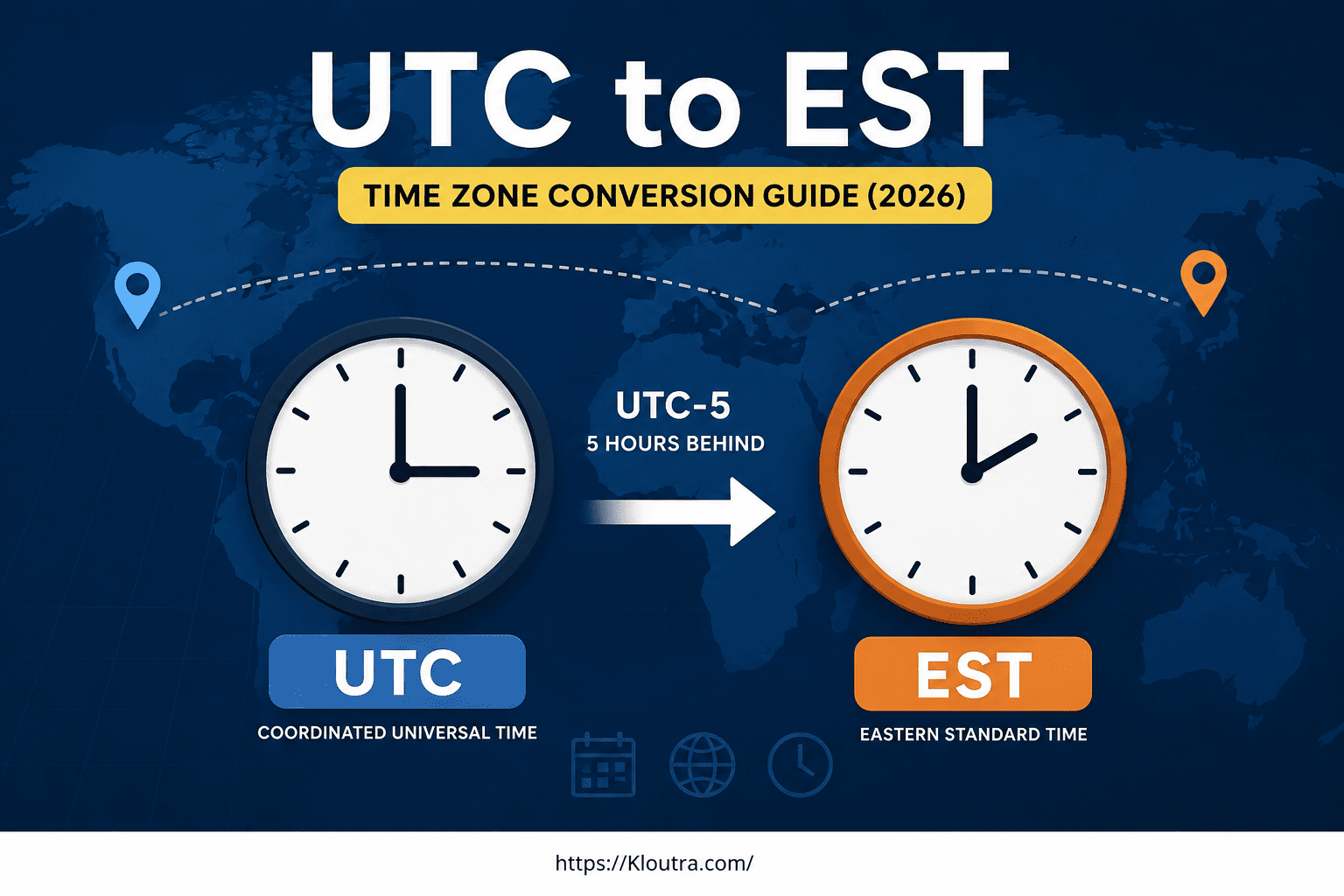
Here’s the core fact you need: EST is 5 hours behind UTC. During daylight saving time, EDT is 4 hours behind UTC.
So the UTC time difference depends on the season:
- Standard Time (EST): UTC − 5 hours
- Daylight Time (EDT): UTC − 4 hours
For example, if it’s 3:00 PM UTC in winter, it’s 10:00 AM EST. But in summer, that same 3:00 PM UTC becomes 11:00 AM EDT.
UTC to EST Conversion Formula
The UTC EST conversion formula is simple once you know the season. Here it is:
EST time = UTC time − 5 hours EDT time = UTC time − 4 hours
Step-by-Step Conversion
- Check the UTC time you’re starting with.
- Confirm whether the U.S. East Coast is currently on EST or EDT.
- Subtract 5 hours (EST) or 4 hours (EDT) from the UTC time.
- Adjust the date if the subtraction crosses midnight.
That last step catches people off guard. For example, 2:00 AM UTC minus 5 hours becomes 9:00 PM the previous day in EST. The date rolls back, not just the time.
When Does the U.S. Switch Between EST and EDT?
Daylight saving time in the U.S. generally starts on the second Sunday of March and ends on the first Sunday of November. Clocks move forward one hour in March (into EDT) and back one hour in November (into EST).
Because these dates can shift slightly or be affected by future policy changes, it’s worth double-checking the exact dates each year using a reliable source like timeanddate.com’s DST change page.
UTC to EST Conversion Examples
Let’s walk through some real-world examples so the formula sticks.
Example 1: Morning UTC Time
- UTC time: 9:00 AM
- Season: Winter (EST)
- Calculation: 9:00 AM − 5 hours
- Result: 4:00 AM EST
Example 2: Afternoon UTC Time
- UTC time: 4:00 PM
- Season: Summer (EDT)
- Calculation: 4:00 PM − 4 hours
- Result: 12:00 PM EDT
Example 3: Late Night UTC Time (Date Change)
- UTC time: 1:00 AM
- Season: Winter (EST)
- Calculation: 1:00 AM − 5 hours
- Result: 8:00 PM EST, the previous day
This last example is exactly why UTC to EST conversion feels tricky. The clock and the calendar can move in different directions at the same time.
Quick Reference Chart
Here’s a simple UTC to EST chart to save you from doing math every time.
| UTC Time | EST (Winter) | EDT (Summer) |
|---|---|---|
| 12:00 AM | 7:00 PM (prev day) | 8:00 PM (prev day) |
| 6:00 AM | 1:00 AM | 2:00 AM |
| 12:00 PM | 7:00 AM | 8:00 AM |
| 3:00 PM | 10:00 AM | 11:00 AM |
| 6:00 PM | 1:00 PM | 2:00 PM |
| 9:00 PM | 4:00 PM | 5:00 PM |
Keep this table handy if you regularly schedule calls between UTC-based teams and East Coast colleagues.
Advantages and Disadvantages of Using UTC vs. EST
Neither UTC nor EST is “better” on its own — each works well in different situations. Here’s how they compare.
Advantages of Using UTC
- No daylight saving confusion. UTC stays the same all year, so there’s no risk of forgetting a clock change.
- Universal reference point. Global teams, pilots, and researchers can all sync to one shared standard instead of juggling multiple local times.
- Easier for software and servers. Most computer systems and databases log timestamps in UTC internally, which reduces bugs from time zone mismatches.
Disadvantages of Using UTC
- Not intuitive for daily life. Most people don’t instinctively know what “14:00 UTC” means for their local morning or evening.
- Requires a conversion step. You still need to calculate the local time, which adds friction for non-technical users.
- Uses 24-hour format. People used to 12-hour AM/PM clocks may find UTC’s format unfamiliar at first.
Advantages of Using EST
- Familiar for East Coast users. Anyone in New York, Toronto, or Miami already thinks in EST or EDT, so no mental math is needed locally.
- Matches local business hours. Store hours, school schedules, and local news all run on Eastern Time, making it practical for daily use.
Disadvantages of Using EST
- Changes twice a year. The switch between EST and EDT is a common source of scheduling mistakes.
- Not useful for global coordination. EST means little to someone in Tokyo or Berlin without a conversion.
- Regional, not universal. It only applies to one part of North America, limiting its usefulness for worldwide planning.
In short, UTC is the better choice for global coordination and technical systems, while EST is more practical for everyday scheduling on the U.S. East Coast.
Why Understanding UTC to EST Matters
You might wonder why this small detail matters so much. Here’s the honest answer: it saves you from real, costly mistakes.
For Remote Workers and Professionals
Missing a meeting because of a time zone mix-up looks unprofessional. Moreover, global teams often list meeting times in UTC specifically to avoid confusion, so knowing the conversion is a basic job skill now.
For Students and Researchers
Online classes, webinars, and academic deadlines are often posted in UTC. Getting the UTC to EST conversion wrong could mean missing a submission window entirely.
For Travelers and Everyday Planning
Flight schedules, live-streamed events, and international news often use UTC. Converting it correctly means you actually catch that event live instead of hours late.
Common Mistakes People Make
- Forgetting daylight saving time: Using a 5-hour offset in summer when it should be 4 hours.
- Not adjusting the date: Subtracting hours without checking if it pushes the time into the previous day.
- Confusing EST with ET: “Eastern Time” (ET) is a general term; EST specifically means standard time, not daylight time.
- Relying on memory instead of tools: Manual math is fine for one conversion, but for recurring meetings, a converter tool avoids repeated errors.
Tools to Convert UTC to EST Instantly
If you don’t want to calculate manually every time, several free tools handle it instantly:
- Online world clock and converter websites
- Calendar apps that auto-adjust time zones for invitees
- Phone and computer clock settings that show multiple time zones
These tools automatically account for daylight saving time, so you avoid the most common conversion mistake. If you’re setting up recurring meetings across time zones, check out Kloutra’s guide to scheduling across time zones for a few extra tips.
FAQ: UTC to EST Conversion
Is EST always 5 hours behind UTC?
No. EST is 5 hours behind UTC only during standard time, roughly November to March. During daylight saving time, the East Coast uses EDT, which is 4 hours behind UTC.
How do I convert UTC to EST manually?
Subtract 5 hours from the UTC time if it’s standard time season, or 4 hours if it’s daylight saving season. Remember to adjust the date if the subtraction crosses midnight.
What is the difference between EST and EDT?
EST (Eastern Standard Time) is used in fall and winter, while EDT (Eastern Daylight Time) is used in spring and summer. EDT is one hour ahead of EST.
Does the UTC to EST time difference ever change?
The core rule stays the same: 5 hours in winter, 4 hours in summer. However, exact daylight saving start and end dates can shift slightly, so it’s smart to verify current dates each year.
Why do companies use UTC instead of local time zones?
UTC gives everyone one fixed reference point with no daylight saving confusion. This makes scheduling across countries far simpler for global teams.
Conclusion
Converting UTC to EST doesn’t have to be confusing once you know the pattern. Remember the core rule: subtract 5 hours during standard time, or 4 hours during daylight saving time, and always double-check if the date shifts too.
Whether you’re joining a global meeting, tracking a live event, or hitting a deadline, this simple UTC to EST time difference knowledge keeps you on schedule. Bookmark this guide or the quick reference chart above, so the next time you see a UTC timestamp, you’ll know exactly what it means for you.
For more scheduling and productivity guides, browse Kloutra’s resource hub or check out our related article on daylight saving time.
Disclaimer
This article is for general informational purposes only. Time zone rules, daylight saving time dates, and government policies can change. Always verify current time zone information using an official source such as time.gov or timeanddate.com before relying on it for critical scheduling, legal, financial, or travel decisions. Kloutra is not responsible for losses resulting from outdated or misapplied time zone information.

Related Posts

Mobile App Development Tips for Beginners

Best Spotify Alternatives for Music Streaming