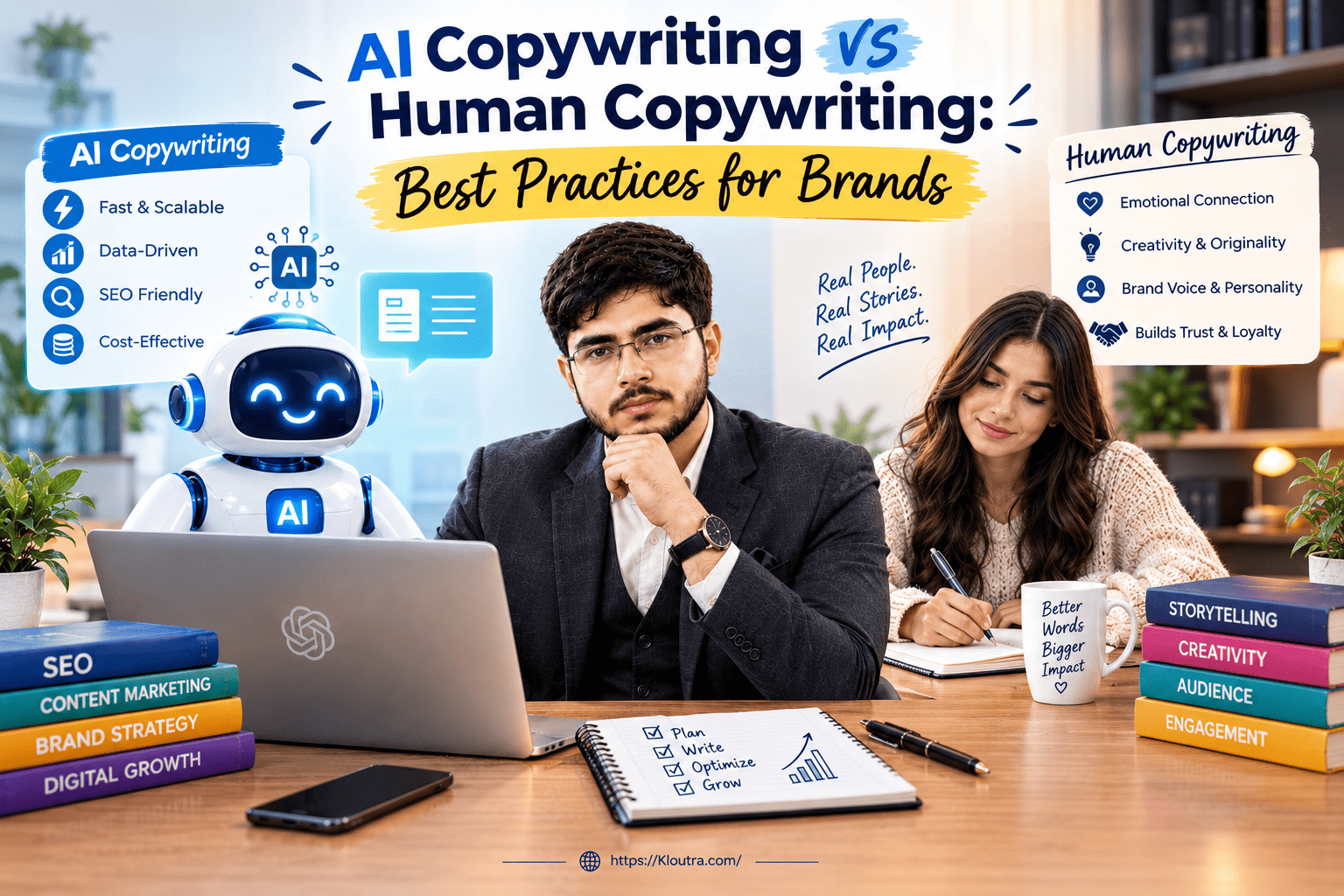
AI Copywriting vs Human Copywriting: Best Practices for Brands
Introduction
Brands need good content to attract and engage their audiences. AI tools are now helping brands create content faster. This has made AI copywriting vs human copywriting an important topic for marketers.
AI can create content quickly and handle a lot of work. Human writers add creativity, context, and a strong brand voice. Both have their own advantages and limits.
In this article, we compare AI and human copywriting. You will learn their key differences and best practices for brands.
What Is AI Copywriting?
AI copywriting means using AI tools to create marketing content. You give the tool a prompt or some basic instructions, and it creates a draft for you. Marketers can use AI for ads, emails, product descriptions, and social media posts. It can also create several versions of the same message for different audiences.
How AI Copywriting Works
AI copywriting tools use language models to create text from your instructions. You provide details about your product, audience, tone, or goal. The tool uses this information to create the copy. You can then give more instructions to improve the result. However, AI may sometimes provide wrong or unsupported information. That is why human review is important before publishing brand content.
Common Uses of AI Copywriting for Brands
Brands use AI copywriting for many routine marketing tasks. It can help create ad copy, email drafts, and product descriptions. It can also support social media posts and content ideas. AI helps teams create multiple content versions more quickly. This can support larger campaigns and different audience segments.
What Is Human Copywriting?
Human copywriting is content written by professional writers or marketers. Writers use research, experience, and audience knowledge to create the copy. They also consider the brand’s goals and communication style. Human writers can adjust their message based on context and audience needs. This approach gives brands more direct creative control.
How Human Writers Create Brand Content
Human writers usually start by researching the brand and target audience. They learn about the product, market, and customer problems. They then create copy that matches the brand’s tone. Writers can also test different messages and improve them through feedback. Their experience helps them make decisions that fit specific situations.
Why Human Creativity Matters
Human creativity helps brands communicate ideas in a personal way. Writers can use stories, emotions, humor, and cultural context. They can also notice details that automated tools may miss. Human review helps catch factual errors and off-brand messaging. This is especially important when content represents a company’s public voice.
AI Copywriting vs Human Copywriting: Key Differences
AI and human writers can both create useful marketing content. Their strengths are different. AI focuses on speed and content production. Human writers focus more on creativity and context.
Creativity and Originality
Human writers can develop original ideas from research and experience. They can understand context and create unique brand messages. AI can generate useful ideas from patterns in its training. AI may produce common or repetitive ideas. Human review can help improve originality and add fresh perspectives.
Speed and Efficiency
AI tools can create drafts much faster than people. They can also produce several versions of one message. This helps marketers handle routine writing tasks more efficiently. Human writing usually takes more time and research. Human writers can make better decisions about context and messaging.
Brand Voice and Emotional Connection
Human writers can understand a brand’s personality and audience. They can use emotions, stories, and cultural context effectively. AI can follow a specific tone when given clear instructions. Still, human editing helps keep the message natural and consistent.
Benefits of AI Copywriting for Brands
AI copywriting can support many everyday marketing tasks. It can help teams save time and produce content more efficiently.
Faster Content Production
AI can quickly create drafts for emails, ads, and product descriptions. This helps marketers handle routine content tasks faster. Teams can then spend more time reviewing and improving the final copy.
Scaling Marketing Campaigns
AI can create multiple content variations for larger campaigns. Marketers can adjust messages for different audiences and platforms. This makes it easier to manage content across multiple marketing channels.
Supporting SEO Content
AI can help marketers organize topics and create initial content drafts. It can also suggest keywords, headings, and content ideas. AI-powered SEO tools can support keyword research and content planning. AI should not replace human judgment in SEO. Google recommends creating helpful, original, people-first content rather than content created only to rank in search results.
Human review also helps improve accuracy, usefulness, and originality. These qualities remain important for search visibility and user trust.
Benefits of Human Copywriting for Brands
Human copywriting gives brands more control over their message. Writers can understand context, audience needs, and brand goals. They can also adjust content based on feedback and experience.
Stronger Brand Voice
Human writers can develop copy that matches a brand’s personality. They can choose words that feel natural and consistent. This helps brands maintain a clear voice across different channels.
Better Storytelling
Human writers can build stories around products and customer experiences. They can connect ideas with emotions and real-life situations. This can make marketing messages easier for people to understand and remember.
Understanding Audience Needs
Human writers can research customer questions, problems, and preferences. They can use this information when creating marketing messages. This helps them address specific needs instead of using generic copy.
When Should Brands Use AI or Human Copywriting?
Brands can use AI and human writing for different content needs. The right approach depends on the task, audience, and content goals.
Best Uses for AI Copywriting
AI works well for routine and repetitive writing tasks. It can create first drafts, content ideas, product descriptions, and email variations. It can also help marketers organize and expand content ideas. Human editors should still check important facts and final messaging. Google also warns against using scaled AI content mainly to manipulate search rankings.
Best Uses for Human Copywriting
Human writers work well on important brand and marketing messages. They can create campaign concepts, stories, and detailed brand content. They can also adapt messages to specific audiences and situations. Human review adds editorial control before important content goes live.
How to Combine AI and Human Copywriting
AI and human writers can work together during the content process. AI can handle routine tasks and create starting drafts. Human writers can improve the content before publication.
Use AI for Research and Drafting
AI can help organize ideas and create initial content drafts. You can provide the topic, audience, and desired writing style. AI can also suggest headings, questions, and different content angles. Generative AI for content marketing can support faster content planning and production. Research should use reliable sources for important factual claims.
Add Human Editing and Expertise
Human editors should review AI-generated content before publication. They can correct errors and remove unclear or repetitive statements. They can also add brand knowledge and useful examples. This creates content that feels more natural and relevant.
Best Practices for AI Copywriting in 2026
AI copywriting works best when people review and improve the results. Google says AI content should provide useful value for people. Content made mainly to manipulate search rankings can violate spam policies.
Fact-Check AI-Generated Content
AI tools can sometimes provide incorrect or unsupported information. Check important facts before publishing any AI-generated copy. Use reliable sources to confirm statistics, claims, and product details. Human review can also catch misleading or outdated information.
Keep Content Original and Natural
Avoid publishing AI drafts without meaningful review or editing. Add original information, examples, experiences, or useful explanations. Google warns against large amounts of unoriginal content created mainly for search rankings.
Maintain a Consistent Brand Voice
Give AI clear instructions about your brand’s tone and audience. Then review every draft for consistency and accuracy. Keep your wording natural across websites, emails, ads, and social posts. Human editors should make the final changes when needed.
How Brands Can Choose the Right Copywriting Approach
Brands should choose their writing approach based on their specific content needs. AI can support routine tasks and faster content creation. Human writers can handle creative work and detailed brand messaging.
Consider Content Goals and Audience
Start by identifying the purpose of your content. Consider your audience, platform, and desired message. AI can help with simple and repetitive content tasks. Human writers can handle content needing deeper context and creativity. A clear AI marketing strategy can also help brands use AI effectively across different marketing tasks.
Balance Quality, Time, and Cost
Consider how much time and effort each task requires. AI can help teams create drafts more quickly. Human writing may require more research, editing, and planning. Choose the approach that fits your content needs and available resources. A combined workflow can also use AI for drafts and human review.
Conclusion
AI and human copywriting both offer useful benefits for brands. AI helps teams create content faster and handle repetitive writing tasks. Human writers add creativity, context, and a stronger brand voice.
The best approach depends on your content goals and audience needs. Many brands can combine AI tools with human editing and review. This approach can improve efficiency while keeping content useful and original.
Brands should always check AI-generated content before publishing it. Content should provide real value and help readers find useful information. Google also recommends people-first content that offers unique and helpful value.
Disclaimer: This article provides general information about AI and human copywriting. AI tools, features, and search guidelines can change over time. Always review AI-generated content before publishing it. Check important facts with reliable sources and use your own judgment when choosing a copywriting approach.