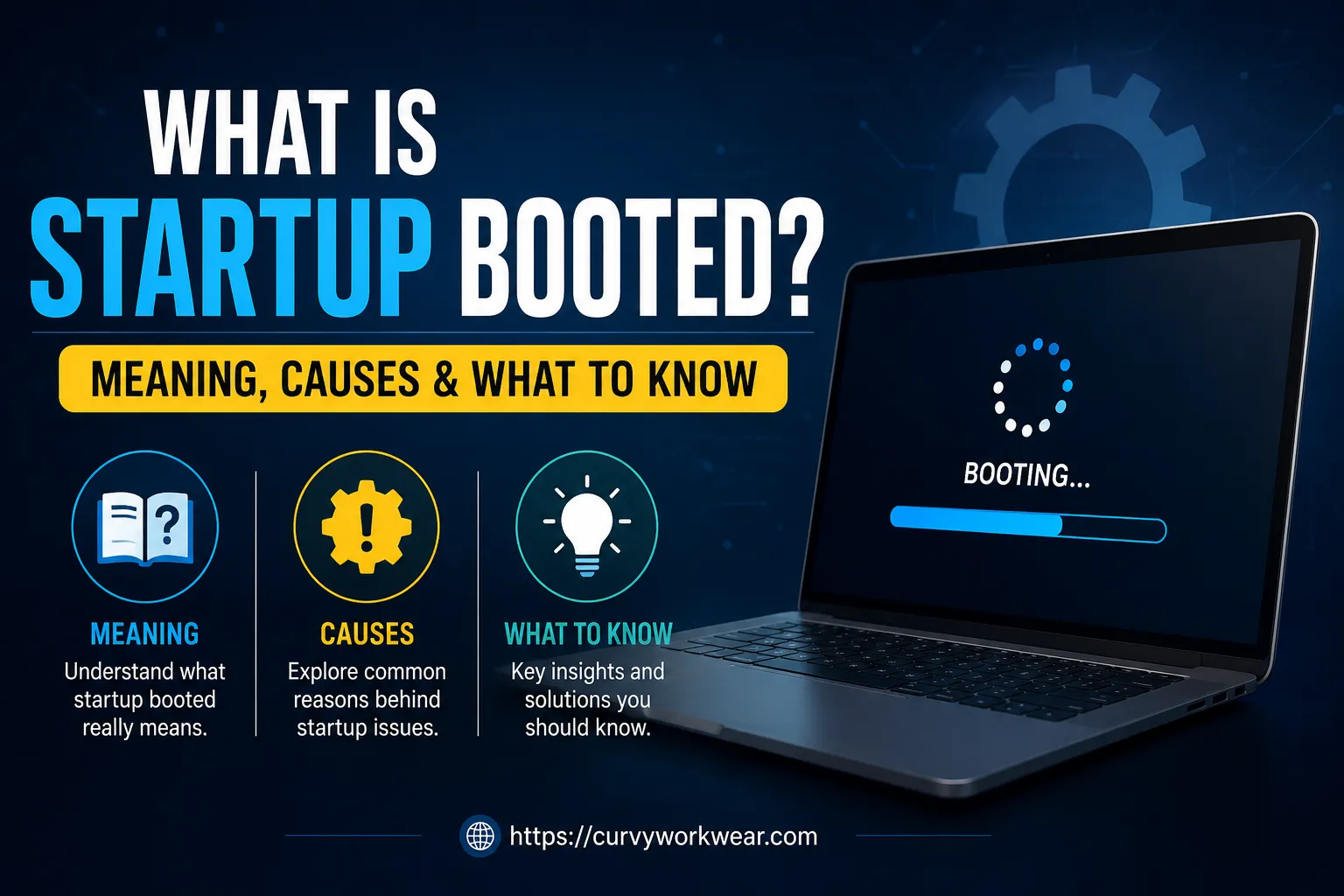
What Is Startup Booted? Meaning, Causes & What to Know
If you searched “startup booted,” you’ve probably noticed something strange. Every article seems to be talking about a different thing. One page explains a computer that won’t turn on. Another talks about companies getting kicked out of accelerators. A third promotes a consulting brand called StartupBooted.com. A fourth uses “booted” to mean “building a company without investors.”
None of them tell you, in one place, which meaning applies to you. That’s the gap this guide fills. Below is every real-world meaning of “startup booted,” organized so you can jump straight to the one you searched for, plus the practical detail — including pros, cons, and working sources — that other pages on this topic tend to skip.
About This Guide
This page was written and fact-checked against primary sources: official vendor support documentation (Microsoft, Apple) and established business-reference sites, linked throughout. Where a claim is a judgment call rather than a fact (for example, “is bootstrapping right for you”), we’ve said so directly instead of presenting opinion as certainty.
Disclaimer: This article is for general informational purposes only. It is not professional IT, legal, financial, or investment advice. Before making a technical repair decision, a business/legal decision, or a financial commitment based on anything here, verify the details for your specific situation, and consult a qualified technician, lawyer, or financial advisor where appropriate.
Quick Disambiguation: Which “Startup Booted” Are You Looking For?
| If your situation is… | Then “booted” means… | Jump to |
|---|---|---|
| Your computer or laptop won’t load past the logo/black screen | A boot failure (technical, hardware/software) | Meaning 1 |
| A company was kicked out of an accelerator, marketplace, or lost its investors | Removed / expelled (business slang) | Meaning 2 |
| You found a website called StartupBooted.com offering pitch decks or financial modeling | A consulting brand name | Meaning 3 |
| You want to build a company using savings and revenue instead of investor money | Bootstrapped growth (“boot” as in “bootstrap”) | Meaning 4 |
| You’re trying to understand why early-stage companies collapse | Startup failure patterns | Meaning 5 |
This ambiguity isn’t an accident. “Boot” independently means “to start a machine,” “to kick out,” and “bootstrap” in English. Startup content sites have published on all three senses using the same keyword. Knowing which “startup booted” you need saves you from reading 4,000 words about the wrong topic.
Meaning 1: “Startup Booted” as a Computer Boot Failure
This is the original, literal, technical use of the phrase. Someone types “why did my startup boot fail” or “startup booted meaning” because their machine turned on but never reached the desktop.
What’s actually happening
Booting is the sequence a computer runs through every time it’s powered on:
- Power-On Self-Test (POST) — the motherboard checks RAM, storage, and core hardware.
- Bootloader handoff — a small program locates your operating system.
- OS loading — Windows, macOS, or Linux loads into memory. This is the stage with the spinning logo.
- Desktop/login screen — if every step succeeds, you’re in.
A “startup boot” failure means the chain broke somewhere in steps 1–4.
The most common causes, ranked by how often they show up
- Corrupted system files — from a sudden power cut, bad update, or malware.
- Failing hard drive or SSD — often with clicking or grinding noises.
- Interrupted software updates — a halted update leaves the OS in a broken state.
- Loose internal cables (desktops) — a SATA or power cable shaken loose.
- Overheating — dust-clogged fans triggering a safety shutdown mid-boot.
- Changed BIOS/UEFI settings — wrong boot order or drive priority.
- Malware targeting startup files — rarer, but real on unprotected systems.
How to tell what you’re dealing with
| Symptom | Likely cause |
|---|---|
| Black screen, no fan change, no drive activity | Power or hardware fault |
| Stuck on manufacturer logo for several minutes | Software/driver conflict |
| Blue Screen of Death with an error code | Identifiable OS-level fault — look up the exact code |
| Reboot loop that never reaches desktop | Corrupted boot files or failing update |
| “Operating system not found” message | Drive not detected, or boot files missing |
Fixing it, in order of least to most invasive
- Force restart — hold the power button 10 seconds, wait, power on again.
- Check cables (desktops) — reseat SATA and power connections.
- Boot into Safe Mode — if this works, the problem is software, not hardware.
- Run Startup Repair (Windows) or Recovery Mode (macOS). See the official guides below.
- Check for overheating — clean vents and fans, let the machine cool, retry.
- Roll back the last update — recovery mode usually offers an “uninstall latest update” option.
- Get a professional diagnosis, especially if you hear clicking or grinding.
One gap most tech articles skip: if Safe Mode also fails to load, that’s a strong signal you’re past a driver conflict and into disk corruption or hardware failure. At that point, stop retrying repairs from the same recovery environment. Each failed attempt can add more writes to a struggling drive. Go straight to a bootable diagnostic USB or a professional, especially if your data isn’t backed up.
DIY repair vs. professional repair — pros and cons
DIY repair (Safe Mode, Startup Repair, cable checks)
- Pros: Free, fast to try, fixes the majority of software-level boot failures.
- Cons: Risky on a physically failing drive, where repeated forced restarts can worsen data loss; requires some technical comfort.
Professional repair
- Pros: Proper hardware diagnosis, safer data recovery from a failing drive, warranty-safe on newer machines.
- Cons: Costs money, takes longer, and isn’t always necessary for simple software fixes.
Preventing it from happening again
- Never power off mid-update.
- Run antivirus scans regularly.
- Clean vents/fans every few months — dust is one of the most overlooked causes of hardware failure.
- Back up important files to an external drive or cloud storage, so a boot failure never means data loss.
Official references: Microsoft: fixing a “boot sector damaged or missing” startup error and Apple: what to do if your Mac won’t turn on.
Meaning 2: “Startup Booted” as a Business Being Removed
In startup and entrepreneurship writing, “booted” is informal slang for removed, expelled, or forced out of a program, platform, or relationship. It’s not a legal or formal business term. Context decides what it means.
Where this shows up
- Booted from an accelerator — for missing program requirements, misrepresenting information, founder disputes, policy violations, legal trouble, a major pivot, going inactive, or reaching an outcome (acquisition, pivot) that makes continued participation unnecessary.
- Booted from a marketplace — for fraudulent transactions, misleading ads, counterfeit goods, IP violations, security or privacy issues, review manipulation, payment irregularities, or failed verification.
- Booted by investors — a looser, more complicated claim. Actual removal of a founder, or shutdown of a company, depends on the specific investment agreement, board rights, ownership structure, and jurisdiction. An investor disliking a decision isn’t the same as having the legal power to act on it.
The single most important thing to understand
Being removed does not automatically mean the company failed. A startup can leave an accelerator because its business model outgrew the program’s design, and keep growing. A company can lose a marketplace listing over a policy technicality and simply move sales to another channel. Reporting and social media tend to flatten all of this into one dramatic word.
| Scenario | What actually happened | Does the business survive? |
|---|---|---|
| Removed from accelerator after a strategic pivot | Voluntary-ish departure, not failure | Often yes |
| Removed from marketplace for policy breach | Platform compliance issue | Often yes, via another channel |
| Lost investor funding, no alternative capital | Serious financial event | Sometimes no |
| Lost funding but found new capital or profitability | Setback, not endpoint | Often yes |
Advantages and disadvantages of this framing
Advantages of treating it as “removed,” not “failed”
- Avoids overreacting to a single news headline.
- Keeps you looking for the actual reason before judging the company.
Disadvantages / risks
- Can be used to spin a genuine failure as a minor technicality.
- Makes it easy to underestimate a real financial or legal problem.
How to verify why a company was actually “startup booted” — a 4-step check
- Identify who made the decision — accelerator, marketplace, investor, partner, regulator?
- Find the stated reason. Treat an organization’s explanation as a claim, not a fact, until independently confirmed.
- Check the startup’s side. The two accounts often diverge meaningfully.
- Check the timeline — when funding arrived, when the dispute started, and what happened after removal often matters more than the removal itself.
Vocabulary that’s more precise than “booted”
Removed · Suspended · Expelled · Discontinued · Shut down · Acquired · Voluntarily exited · Restructured. Each communicates a different, checkable outcome, and using the accurate one avoids treating an ordinary business transition as a scandal.
Meaning 3: “StartupBooted” as a Consulting/Publishing Brand
Separately from the slang usage above, StartupBooted.com is the name of a business-growth website that advertises paid startup consulting.
What it publicly sells (as of its current pricing pages)
| Service | Advertised starting price | What it’s for |
|---|---|---|
| Investor pitch deck design | $5,000 | Building the investor narrative and slides |
| Financial modeling & budgeting | $10,000 | Forecasts, budgets, scenario models |
| Fundraising strategy | $2,000 | Positioning and targeted outreach planning |
It also runs a separate guest-posting/link-building offer — a different service from the consulting work, worth mentally separating before you inquire about either.
Pros and cons of hiring a startup consulting service like this
Pros
- Can save founders time on unfamiliar tasks like financial modeling.
- Brings outside experience with investor-facing materials.
Cons
- “Starting at” pricing rarely reflects the final invoice.
- No document can manufacture product-market fit, real demand, or founder credibility — those are prerequisites, not outputs, of the engagement.
- Success-fee arrangements tied to money raised can trigger securities/broker-dealer registration requirements, regardless of what the fee is called.
What to verify before paying anyone in this space
A similarly named domain (StartupBootedFundraising.com) exists with no publicly confirmed ownership link to the first site. Treat any engagement here like hiring a professional-services vendor:
- Get the exact legal entity that will invoice you, in writing.
- Ask exactly who performs the work, not just who signs the proposal.
- Ask for reference clients you can actually contact.
- Get the deliverable format and number of revisions specified in the contract, not the sales page.
- If the engagement involves contacting or negotiating with investors on your behalf, confirm — separately, with a lawyer if the amounts are significant — whether that activity requires securities/broker-dealer registration.
Meaning 4: “Startup Booted” as Bootstrapped Growth
A looser, increasingly common usage treats “startup booted” as shorthand for “bootstrapped startup.” That’s a company grown on founder savings, early revenue, and reinvested profit rather than outside investment, sometimes blended with selective fundraising once real traction exists.
What this approach typically relies on
Founder savings and loans, customer prepayments, early sales, reinvested profits, lean teams, disciplined hiring, non-dilutive grants, and founder-controlled decisions. Outside capital, if it happens at all, comes in only after the founder has evidence the business works. For a fuller definition and history of the term, see Shopify’s guide to what bootstrapping means.
Advantages and disadvantages of bootstrapping
Advantages
- Full control — no investor board seats or outside veto power.
- No equity dilution, so founders keep more of the upside.
- Forces financial discipline early, which often improves margins later.
- Freedom to pivot quickly without investor approval.
Disadvantages
- Growth is capped by whatever cash the business itself generates.
- Founder bears the full personal financial risk.
- Harder to compete against well-funded rivals in a land-grab market.
- Slower hiring can mean slower time-to-market on some opportunities.
Where most bootstrapped startups actually fail — in order
- Building before validating. Confirm customers will pay, not just that they’re interested, before writing code or spending real money. Free users rarely convert into paying ones later.
- Confusing revenue with cash. A company can grow on paper and still fail because customer payments arrive slower than bills go out. Track cash flow, not just booked revenue.
- Hiring too early. Every full-time hire is a fixed cost. Add headcount only when revenue justifies the salary, or you’re turning away business without it.
- Pricing too low from the start. Low prices feel competitive but compress margin and limit reinvestment.
- Running the runway calculation. Runway = Available Cash ÷ Monthly Net Cash Burn. A company with $600,000 in the bank burning $50,000/month has roughly 12 months. Know this number at all times.
- Staying dependent on one channel. A business that lives entirely on one marketplace, ad channel, or partner carries concentration risk.
A simple 90-day sequence for a founder deciding whether to bootstrap or raise
- Days 1–30: Validate the problem — customer interviews, pricing tests, pilot customers.
- Days 31–45: Build the financial foundation — startup costs, a 12-month cash forecast, a runway estimate.
- Days 46–60: Convert pilots into paying customers and start tracking retention.
- Days 61–75: Draft the pitch story only after the numbers above exist, so the deck and the model agree.
- Days 76–90: Decide, with real evidence in hand, whether outside capital is actually necessary.
Meaning 5: Why New Startups Fail Early
Several “startup booted” searches are really people trying to understand startup mortality in general. The recurring, evidence-backed reasons early-stage companies collapse:
- No real market need — building a product before confirming anyone will pay for it.
- Running out of cash — the single most common proximate cause, regardless of the deeper reason behind it.
- Wrong team composition — solo founders often raise less and grow slower than balanced founding teams.
- Getting outcompeted — ignoring competitors and substitutes until it’s too late to respond.
- A pricing or business model that can’t reach profitability even with growth.
- Scaling prematurely — hiring, spending, or expanding faster than validated demand supports.
- Founder conflict — disagreements over equity, direction, or workload that go unaddressed.
- Refusing to pivot, or pivoting too often. Startups that adjust once or twice tend to outperform ones that never adjust, and ones that never settle on a direction.
Putting It All Together
“Startup booted” isn’t one topic. It’s five unrelated ones sharing a search term: a technical failure, a piece of business slang, a company name, a financing philosophy, and a broader question about why startups die. If you arrived here with a specific worry — a frozen computer, a company you’re researching, a consulting quote you received, or your own bootstrapping decision — the matching section above is the one worth reading closely. The rest is context for why the same three words keep pointing in different directions.(our guide)
Disclaimer: This article is for general information only. It is not legal, financial, or investment advice. Startup agreements, accelerator contracts, and board disputes vary widely, so speak with a qualified lawyer or advisor before acting on anything removal-related.