AI Transformation Is a Governance Problem: The Complete Guide for 2026
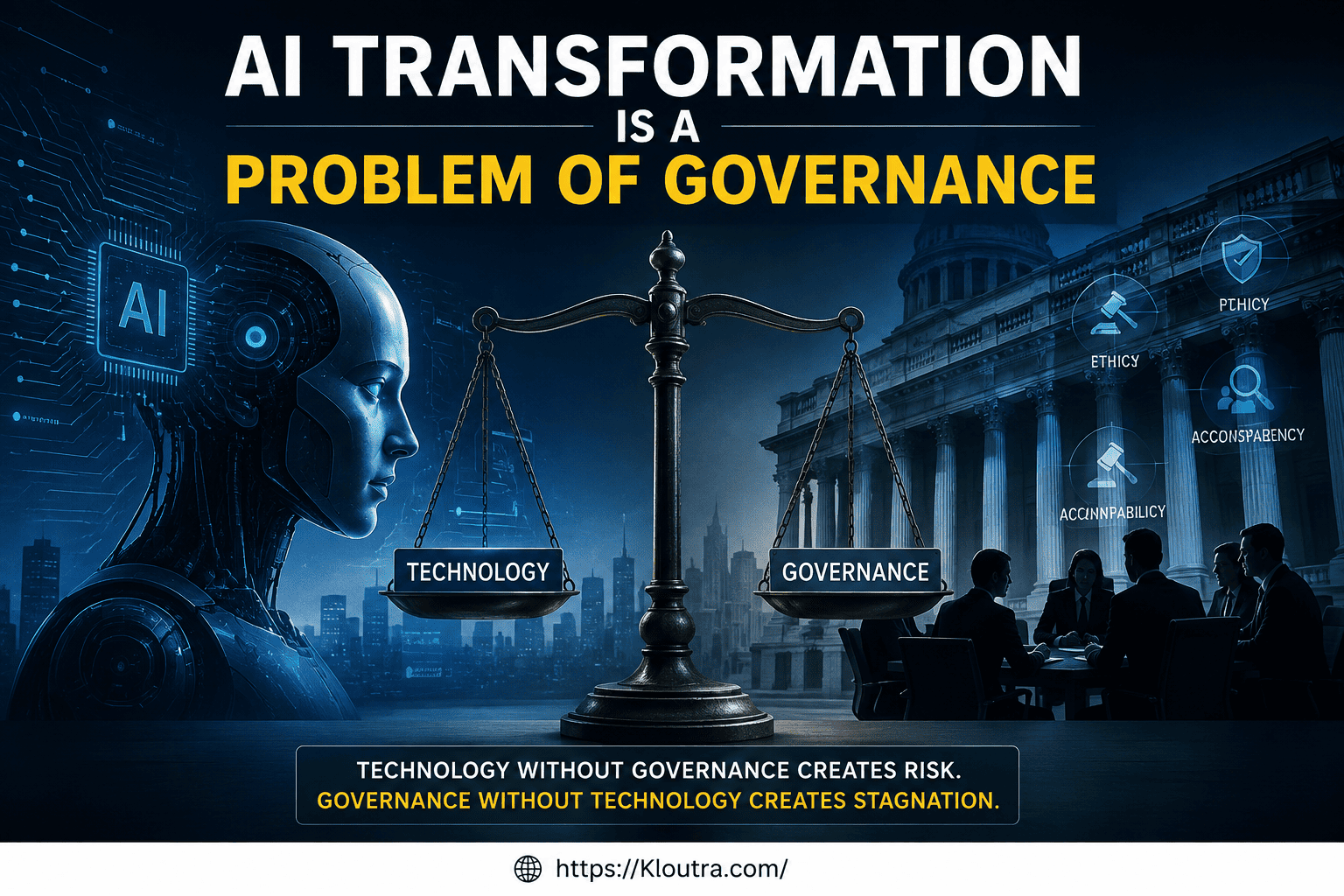
Most companies think their AI project failed because of bad data or the wrong tool. That’s rarely the real story. In truth, AI transformation is a problem of governance, not a technology problem.
Without clear rules for who decides what, who checks the output, and who takes the blame when something goes wrong, even the best AI model turns into a liability. This guide breaks down why governance sits at the center of every successful AI rollout, and what you can actually do about it in 2026.
Why AI Transformation Is a Problem of Governance, Not Just Tech
Gartner and other research firms have long pointed out that most AI pilots never make it to full production. The reason usually isn’t the algorithm. It’s the organization around it.
Think of it like handing someone the keys to a car without teaching them the traffic rules. The car works fine. The crash happens because nobody agreed on who has the right of way.
The Technology Trap
Leaders often buy a shiny AI tool and expect results overnight. However, a tool without oversight just automates confusion faster.
Teams start using AI in different ways, with no shared standard for accuracy, privacy, or bias checks. That’s not an implementation glitch. That’s a governance gap.
The Missing Ownership Problem: A Governance Problem in Disguise
In many companies, nobody actually owns AI outcomes. IT built it, legal reviewed it once, and business teams use it daily.
When something breaks, three departments point at each other. This is exactly why AI transformation is a problem of governance long before it’s a problem of code.
What “AI Governance” Actually Means
AI governance is the set of rules, roles, and checks that decide how AI gets built, used, and monitored inside an organization. It’s not a single policy document. It’s an ongoing system.
A solid AI governance framework usually covers four things: who approves new AI use cases, how models get tested before launch, how outputs get monitored after launch, and who is accountable if something goes wrong.
Governance vs. Compliance
These two get confused often, but they’re not the same thing.
Compliance means following external rules — laws, industry standards, and regulations. Governance is broader. It’s your internal system for making good decisions, even in situations no regulation has covered yet.
Why This Matters More in 2026
AI regulation 2026 looks very different from just a few years ago. According to the European Commission’s official AI Act page, the Act became fully applicable on August 2, 2026, though rules for high-risk AI systems in sensitive areas like employment and education were pushed back to December 2027 after a simplification update. In the US, states have been passing their own AI laws at a fast pace, creating a patchwork rather than one clear rulebook.
This shifting landscape means a governance framework built for last year’s rules may already be outdated. Companies that treat governance as a one-time project, instead of a living system, will keep struggling to keep up. Because these dates can shift again, always check the official EU source before making compliance decisions.
The Real AI Adoption Challenges Companies Face
Most AI adoption challenges trace back to governance gaps, even when they look like something else on the surface.
Data Quality and Ownership
Bad data creates bad AI outputs. But the deeper issue is usually: nobody was assigned to own data quality in the first place.
Without a named owner, data problems just get discovered after the damage is done.
Employee Trust and Adoption
Employees won’t use a tool they don’t trust. If staff don’t know how decisions get checked or who is responsible for mistakes, they’ll quietly avoid the system.
For example, a customer service team might stop using an AI chatbot suggestion feature because a wrong answer once went out under their name, with no clear process for reporting it.
Vendor and Third-Party Risk
Many companies plug in AI tools from outside vendors without checking how those tools were trained or tested. This is a common blind spot.
A governance framework should include vendor review as a standard step, not an afterthought.
Building an AI Governance Framework That Works
A workable AI implementation strategy starts with governance, not with picking a model. Here’s a practical structure to follow.
Step 1: Set Clear Ownership
Assign a specific person or small committee to own AI decisions. This group should include people from legal, IT, and the business side — not just technical staff.
Without this step, everything else in your framework becomes optional in practice.
Step 2: Classify AI Use Cases by Risk
Not every AI use case needs the same level of scrutiny. A tool that drafts marketing emails carries far less risk than one that screens job applicants.
Sort your AI projects into risk tiers, and match your review process to that risk level. This is central to good AI risk management. If you want a ready-made structure instead of building one from scratch, the NIST AI Risk Management Framework is a free, widely used starting point.
Step 3: Create Testing and Monitoring Checkpoints
Test AI systems before launch, and keep testing after launch. Models can drift over time as real-world data changes, which means a system that worked well in January might behave differently by December.
Set a regular schedule for review, not just a one-time check.
Step 4: Document Decisions and Accountability
Write down who approved each AI use case, and why. If regulators or customers ever ask questions, you need a paper trail, not a guess.
This documentation also helps new employees understand how the system is supposed to work.
Common AI Governance Risks to Watch in 2026
Bias and Fairness Gaps
AI models can pick up bias from historical data without anyone intending it. For example, a hiring tool trained on past resumes might unintentionally favor certain backgrounds if those patterns existed in the original data.
Regular bias audits are becoming a standard part of AI risk management, not an optional extra.
Shadow AI Usage
Employees often use AI tools on their own, without approval, simply because it’s faster. This is sometimes called “shadow AI,” and it’s a growing governance risk because leadership has no visibility into what data is being shared or how outputs are used.
Regulatory Fragmentation
Because AI regulation 2026 varies by country and even by US state, a global company might need different governance rules for different regions. This adds complexity, but skipping it isn’t an option if you operate across borders.
How to Align AI Transformation Strategy With Governance
Your AI transformation strategy and your governance framework should be built together, not one after the other.
Start Small, Then Scale
Pick one or two low-risk AI use cases first. Build your governance process around them, then expand once the process is proven.
This is far safer than rolling out AI company-wide and trying to add governance afterward.
Make Governance Part of Culture, Not Just Policy
Rules on paper don’t help if nobody follows them day to day. Train employees on what’s allowed, what needs approval, and how to flag problems.
In short, governance works best when it feels like part of the job, not an obstacle to it.
Review and Update Regularly
AI tools, laws, and risks change fast. A governance framework needs a scheduled review, at least once or twice a year, to stay useful.
Advantages and Disadvantages of Putting Governance First
Leading with governance isn’t free. It’s worth weighing what you gain against what it costs, so you can set expectations correctly before you start.
Advantages of Strong AI Governance
- Fewer costly surprises. Problems like biased outputs or data leaks get caught in review, not after a customer complains.
- Faster approvals over time. Once risk tiers and checklists exist, new AI projects move through review faster because nobody is figuring out the process from scratch.
- Easier audits and regulator conversations. Documented decisions mean you can answer “why did you build this” without scrambling.
- Higher employee trust. Staff are more willing to use AI tools when they know there’s a clear way to flag problems.
Disadvantages of Strong AI Governance
- Slower initial rollout. Setting up ownership, risk tiers, and review steps takes real time before any AI project goes live.
- Extra administrative work. Documentation and regular reviews add ongoing effort, which can feel like overhead to fast-moving teams.
- Requires cross-department buy-in. Governance only works if legal, IT, and business teams actually cooperate — getting that alignment can be slow in larger organizations.
- Risk of over-engineering. Applying heavy review to low-risk AI use cases (like an internal note-summarizing tool) can frustrate teams and slow down harmless work.
In short, governance trades some short-term speed for long-term stability. For most companies, that trade is worth it — but the right level of governance should match the actual risk of each AI use case, not be applied uniformly everywhere.
FAQ
Why is AI transformation considered a governance problem?
AI transformation is a problem of governance because most failures come from unclear ownership, weak oversight, and missing accountability, not from the technology itself. A good model with no governance structure around it can still cause serious harm or simply get abandoned.
What is the difference between AI governance and AI compliance?
Compliance means following external laws and industry rules. Governance is your internal system of roles, checks, and decisions that guides how AI is used, even in areas the law hasn’t addressed yet.
What are the biggest AI adoption challenges in 2026?
The most common AI adoption challenges are poor data ownership, low employee trust, unclear accountability, and unreviewed third-party tools. Most of these trace back to weak governance rather than weak technology.
How do companies manage AI governance risks?
Companies manage AI governance risks by classifying use cases by risk level, testing and monitoring models regularly, documenting who approved what, and auditing for bias. This turns governance from a one-time task into an ongoing process.
Is AI regulation the same everywhere?
No. AI regulation 2026 differs by country and, in the US, even by state, which creates a patchwork of rules rather than one global standard. Companies operating internationally should expect this to keep changing and review their governance framework regularly.
Conclusion: AI Transformation Is a Problem of Governance First
AI transformation is a problem of governance before it’s ever a problem of algorithms or infrastructure. The companies that succeed in 2026 won’t necessarily have the fanciest models. They’ll have clear ownership, tested review processes, and a governance framework that adapts as rules and risks change.
If you’re planning your next AI project, start with the governance questions first: who owns this, who checks it, and who is accountable. Get those answers in place, and the technology part becomes much easier to manage.
Disclaimer: This article is for general educational purposes only. It is not legal, compliance, or regulatory advice. AI laws like the EU AI Act and US state regulations change frequently and vary by jurisdiction and industry. Before making governance, compliance, or risk decisions for your organization, consult a qualified legal or compliance professional.

Related Posts

Chosenly Company Type: Services, Features & Business Model

Mobile App Development Tips for Beginners