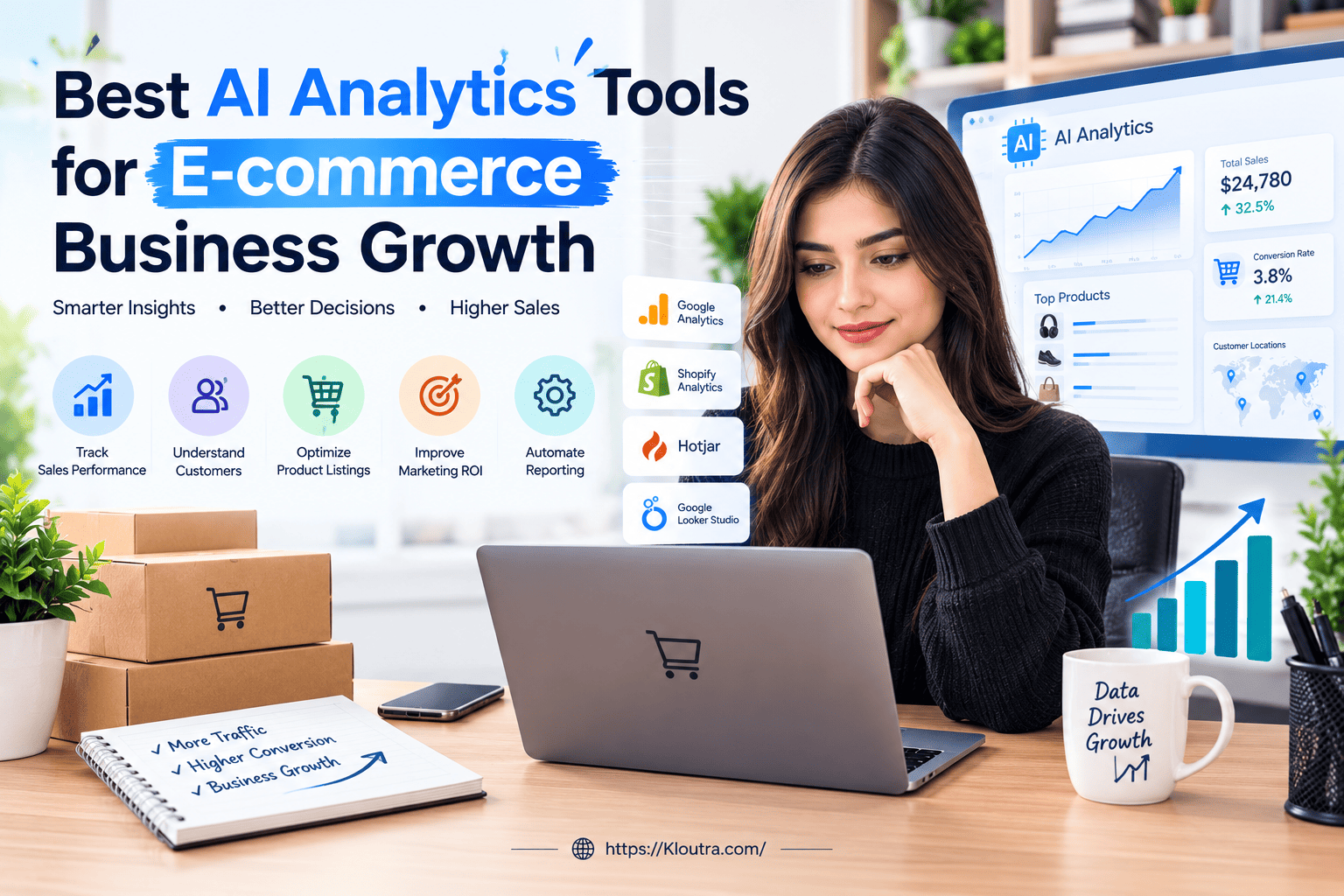
Best AI Analytics Tools for E-commerce Business Growth
Introduction
E-commerce businesses generate large amounts of customer and sales data every day. AI analytics tools for ecommerce help businesses analyze this data and find useful insights faster.
In this guide, you will learn how AI analytics tools work, what data they analyze, and how they can support e-commerce growth. You will also discover key features and trends to consider when choosing an AI analytics tool.
What Are AI Analytics Tools for Ecommerce?
AI analytics tools for ecommerce use artificial intelligence to analyze business data. They can find patterns, trends, and useful customer insights. These tools help businesses understand what happens across their online stores.
How AI Analytics Works
AI analytics tools collect data from different ecommerce sources. They can then process the data and identify useful patterns. Some tools use machine learning to make predictions from historical data.
These insights can help businesses understand sales and customer activity. They can also support decisions about marketing, products, and inventory.
What Ecommerce Data Can AI Analyze?
AI can analyze many types of ecommerce data. This includes sales, purchases, product views, and customer behavior. It can also analyze browsing activity, email engagement, and customer interactions.
AI can also examine cart activity, checkout behavior, and product performance. Proper tracking and data collection are needed for accurate analysis.
Why Use AI Analytics for Ecommerce?
AI analytics can help ecommerce businesses turn large datasets into useful insights. It can reduce manual analysis and support faster business decisions.
Understand Customer Behavior
AI can identify patterns in customer browsing and purchasing behavior. It can group customers based on shared behaviors and interests. This helps businesses understand different customer segments more clearly.
Improve Sales and Marketing Decisions
AI analytics can show which products, channels, and campaigns perform well. Businesses can use these insights to adjust their AI marketing strategy. Analytics can also help identify problems within the shopping journey.
Predict Ecommerce Trends
AI can use historical data to estimate future customer and sales behavior. Predictive analytics can support demand forecasting and customer purchase predictions.
These predictions are estimates, not guaranteed outcomes. Businesses should combine AI insights with human judgment.
AI Analytics Tools for E-commerce
The right tool depends on your store size and analytics needs. Some tools focus on sales and revenue data. Others focus on customer behavior or marketing performance.
AI Tools for Sales and Revenue Analytics
Google Analytics 4 tracks ecommerce events, purchases, product interactions, and customer journeys. Its machine learning features also provide predictive metrics for eligible properties.
Shopify Analytics provides sales reports, dashboards, and store performance data. Shopify also offers AI-powered insights through its Sidekick assistant.
AI Tools for Customer Analytics
Microsoft Clarity uses session recordings and heatmaps to show customer behavior. Its AI features can summarize user behavior and highlight useful patterns.
Google Analytics 4 can help businesses understand customer actions across ecommerce journeys. Its reports can show how users interact with products and websites.
AI Tools for Marketing Analytics
Google Analytics 4 can measure marketing and ecommerce performance from website data. Businesses can connect analytics data with advertising platforms for audience targeting.
Shopify Analytics helps merchants review sales across different channels. Its reports can show which channels contribute to store performance.
Key Features to Look for in AI Analytics Tools
A useful analytics tool should provide clear insights from relevant business data. Look for features that match your store’s specific needs.
Predictive Analytics
Predictive analytics uses existing data to estimate future customer behavior. Some tools can estimate purchase or churn probabilities.
These predictions can help businesses plan campaigns and understand customer activity.
Customer Segmentation
Customer segmentation groups users based on shared characteristics or behaviors. Analytics tools can help create audiences from customer activity and purchase data.
This helps businesses understand different customer groups more clearly.
Automated Insights and Reports
Automated insights can highlight unusual changes or emerging trends. Google Analytics can generate automated insights from your collected data.
Shopify can also provide insights into sales and customer activity. These insights can help merchants notice important changes in store performance.
How AI Analytics Helps E-commerce Business Growth
AI analytics helps businesses understand their store data more clearly. It can reveal patterns in sales, products, and customer behavior.
Improve Customer Experience
Analytics can show how customers move through an online store. Businesses can track product views, cart activity, and purchases.
This information helps identify problems in the shopping journey. Businesses can then improve product pages, navigation, or checkout steps.
Optimize Products and Pricing
Analytics can show which products receive views and purchases. Businesses can compare product performance using sales and engagement data.
These insights can support better product and pricing decisions. However, analytics does not automatically determine the right price.
Businesses should also consider costs, competition, demand, and customer expectations.
Increase Customer Retention
AI analytics can help businesses understand customer purchase patterns. Businesses can use this information to create relevant customer groups.
They can then improve marketing and customer experiences for those groups. Better understanding can support stronger relationships with returning customers.
How to Choose AI Analytics Tools for Ecommerce
Choosing the right tool depends on your store’s needs and available data. Focus on simple features that support your business goals.
Check Integrations and Ease of Use
Choose tools that connect with your ecommerce platform and other systems. Good integrations reduce manual data work and setup problems.
The tool should also have clear dashboards and simple reports. This makes it easier to understand your data and insights.
Compare Features and Pricing
Compare features based on the type of data you need. Check sales reports, customer analytics, forecasting, and reporting options.
Also, compare pricing with your store’s size and expected usage. Avoid paying for features that your business does not need.
Consider Data Security
Check how the tool collects, stores, and uses your business data. Review its privacy policy and data access requirements before connecting it.
Limit access to only the data the tool actually needs. Also, review any AI-generated actions before applying them.
AI Analytics Trends in Ecommerce
AI analytics continues to change how ecommerce businesses use customer data. Predictive insights and personalization are important areas today.
Predictive Customer Insights
AI can use customer activity to estimate future purchasing behavior. For example, Google Analytics offers purchase and churn probability metrics.
These insights can help businesses create more targeted customer audiences. Predictive features require enough suitable data and may not suit every store.
AI-Powered Personalization
AI can personalize shopping experiences using customer behavior and preferences. It can support product recommendations, search results, and targeted marketing.
Businesses can use browsing and purchase data for these experiences. Good data quality helps personalization systems provide more relevant results.
Automated Data Analysis
AI tools can reduce the manual work involved in data analysis. They can highlight patterns, changes, and useful business insights.
Some tools also let users explore data through natural language. However, businesses should still review AI-generated insights for accuracy.
Conclusion
AI analytics tools can help ecommerce businesses understand data more clearly. They can reveal customer behavior, sales patterns, and product performance.
The right tool depends on your business needs and available data. Choose tools with useful features, simple reporting, and suitable integrations. Always review AI insights before making important business decisions.
Disclaimer: The information in this article is for general informational purposes only. AI analytics tools, features, pricing, and availability may change over time.
Always check official sources for the latest tool information before making business decisions. Results may vary based on your business, data, and how you use each tool.