What Are the Three Main Factors That Determine Ad Quality?
Introduction
Understanding what are the three main factors that determine ad quality? can help you create better Google Ads campaigns and make smarter decisions. Every click costs money, so your ads must attract the right people and meet their expectations. Google evaluates three key components: expected click-through rate, ad relevance, and landing page experience. Each factor reveals how well your ad connects with a user’s search and delivers useful information.
When you understand these elements, you can identify weak spots and improve campaign performance. In this guide, you’ll learn how each factor works, how to check your Quality Score, and which practical steps can help you get more value from your advertising budget.
What Are the Three Main Factors That Determine Ad Quality?
Running ads is easy. Getting the right people to click and take action is harder. In digital advertising, success depends on how well your ad matches a user’s needs and delivers on its promise. A larger budget cannot fix every problem.
The three main factors that determine ad quality in Google Ads are expected click-through rate, ad relevance, and landing page experience. Google uses these components to calculate its keyword-level Quality Score, a diagnostic rating from 1 to 10. Understanding each factor helps you make smarter campaign decisions, improve your ads, and use your budget more effectively.
1. What Is Ad Quality in Google Ads?
Ad quality describes how useful and relevant an advertisement is to the person seeing it. A strong ad matches the user’s search, communicates a clear benefit, and leads to a helpful page. For example, someone searching for emergency plumbing services expects quick assistance, clear service details, and an easy way to call. An ad that meets those needs offers a better experience than a vague message about home improvement.
However, overall ad quality and Google’s Quality Score are not exactly the same. Google reports Quality Score on a scale of 1 to 10 at the keyword level. It uses three diagnostic components: expected CTR, ad relevance, and landing page experience. These ratings help advertisers identify weaknesses. They do not represent a complete measure of campaign success or directly determine every auction outcome.
2. Why Does Ad Quality Matter?
Good ad quality can help you attract visitors who are more likely to become customers. When your message matches a person’s needs, they can quickly understand your offer. This supports better ad campaign performance and may improve your conversion rate. For a US business, that could mean more qualified service inquiries, product orders, or appointment bookings instead of wasted clicks.
Ad quality also matters when you manage advertising costs. Google’s auction considers several signals when deciding which ads can appear and where they may show. Better quality can help an ad compete more effectively, although results depend on other factors too. Track leads, sales, and return on ad spend (ROAS) instead of judging success by clicks alone. Strong advertising ROI comes from turning suitable traffic into valuable business results.
3. What Are the Three Main Factors That Determine Ad Quality?
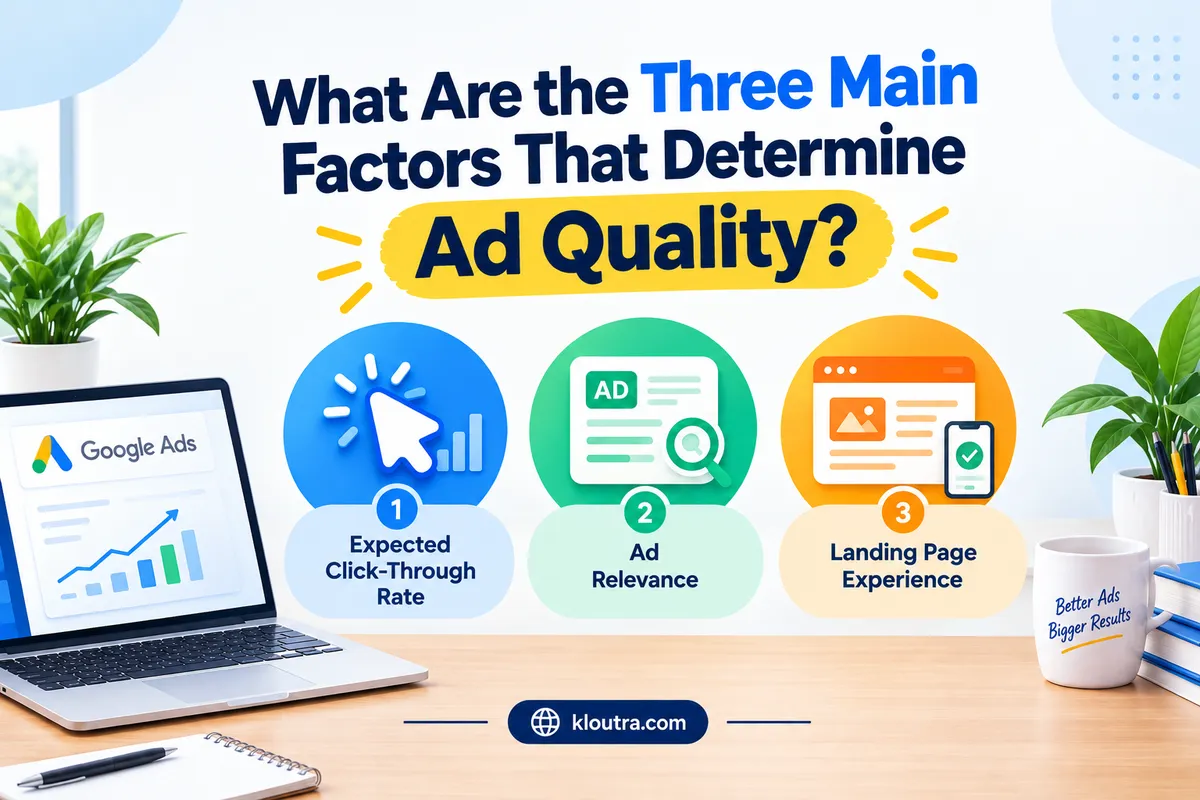
The answer to what are the three main factors that determine ad quality? starts with Google’s official framework. The first factor is expected CTR, which estimates how likely someone is to click your ad. The second is ad relevance, which measures how closely your ad matches a search. The third is landing page experience, which reflects the usefulness and relevance of the page people reach after clicking.
These ad quality factors work together, but each measures something different. A relevant ad may still struggle if its headline lacks appeal. A strong headline may attract clicks but disappoint visitors when the page fails to deliver. For effective ad performance optimization, examine each component separately. Then improve the weakest area while monitoring leads, sales, and other meaningful results.
| Official factor | What it measures | What you should review |
| Expected CTR | Likelihood of a click | Ad appeal and historical click signals |
| Ad relevance | Connection between the ad and search | Keyword match and search intent |
| Landing page experience | Usefulness of the destination page | Relevance, transparency, and usability |
Factor 1: Expected Click-Through Rate
The expected click-through rate estimates how likely your ad is to receive a click when Google shows it for a particular search. Google considers historical performance signals when assessing this component. Your actual CTR measures the clicks you receive divided by impressions. Expected CTR is a separate diagnostic estimate, so the two figures may differ.
To improve this factor, write a clear ad headline and use compelling ad copy that explains a real benefit. For example, a US cleaning company could advertise same-day booking rather than simply saying it offers cleaning services. Strong benefit-driven messaging gives people a reason to choose your ad. However, never promise a service or result that your business cannot deliver.
Factor 2: Ad Relevance
Ad relevance measures how closely your ad connects with a person’s search. This starts with understanding search intent and conducting useful keyword research. Someone searching for emergency AC repair needs a different message from someone comparing new air-conditioning systems. Although both searches concern HVAC services, their immediate needs differ. Your ad should address the specific problem behind each query.
Good keyword alignment helps create that connection. Organize related search terms into focused ad groups, then write relevant headlines and descriptions. Audience targeting can support your strategy, while audience segmentation helps you tailor messages to different customer groups. Google’s dynamic keyword insertion can adapt ad text to eligible search terms, but it needs careful setup. Keyword insertion cannot replace useful copy or correct targeting.
Factor 3: Landing Page Experience
The landing page experience reflects how relevant and useful your destination page is to people who click your ad. A visitor should find the information promised in the advertisement without unnecessary effort. If an ad promotes a specific product discount, the landing page should explain that offer clearly. Sending visitors to a broad homepage can create confusion and weaken the connection between the search, ad, and destination.
Effective landing page optimization begins with relevant landing page content, clear navigation, and a trustworthy design. Strong mobile responsiveness matters because visitors use different screen sizes and devices. Improving mobile user experience and mobile page speed can reduce frustration. Review your page load speed, forms, contact details, and checkout steps. A useful page makes the next action clear without distracting visitors with unrelated offers.
4. How Does Google Ads Quality Score Work?
Google calculates Quality Score on a scale from 1 to 10 for individual eligible search keywords. The score helps advertisers compare their performance with other advertisers whose ads appeared for the same keyword. Google also reports component ratings as above average, average, or below average. These ratings can help you identify whether expected CTR, ad relevance, or landing page experience needs attention.
However, a high score does not guarantee a top ad position or a low cost per click (CPC). Google’s real-time ad auction uses auction-time quality assessments alongside bids, competition, search context, and other signals. The reported Quality Score is a diagnostic tool, not a direct auction input. Use it to find potential weaknesses, then check whether your changes improve actual business outcomes.
| Quality Score component | Possible rating | What to investigate |
| Expected CTR | Above average, average, or below average | Ad appeal and relevance to searchers |
| Ad relevance | Above average, average, or below average | Alignment between queries and ad text |
| Landing page experience | Above average, average, or below average | Page usefulness and relevance |
5. How Do You Check Your Google Ads Quality Score?
You can review Quality Score directly in your Google Ads account. Open the Keywords section of your Search campaign and customize the columns to display Quality Score, expected CTR, ad relevance, and landing page experience. These columns show where Google identifies potential weaknesses. If a score is missing, the keyword may not have enough eligible data for a rating.
Next, compare the component ratings with campaign results. Google Analytics can help you understand what visitors do after reaching your website. Set up conversion tracking to measure actions such as purchases, calls, and completed lead forms. Combine these insights with marketing analytics to identify useful patterns in user behavior. This approach helps you see whether improved ad quality also supports stronger business performance.
6. How Can You Improve Your Ad Quality Score?
Start by identifying the component with the weakest rating. If expected CTR needs attention, test clearer headlines and more specific benefits. If ad relevance is below average, review your keywords and make sure your ad answers the searcher’s need. If landing page experience is weak, improve the page’s relevance, usability, and clarity. This focused approach makes campaign optimization easier to measure.
Next, assess how people respond to your changes. A clear call to action (CTA) can encourage visitors to take the next step. Place useful call-to-action buttons where people can find them easily. Improve forms and remove unnecessary distractions. Conversion rate optimization also involves testing page layouts and offers without sacrificing trust. Monitor conversions and costs before deciding whether a change has helped.
Use Ad Quality Data to Guide Improvements
Imagine a US roofing company receives plenty of clicks but few quote requests. Its ads mention roofing services broadly, while its landing page covers several unrelated offerings. The company can create separate ads for roof repairs and replacements, then send visitors to matching pages. This improves the connection between customer pain points, ad messaging, and the next step.
Review the results over a meaningful period rather than reacting to every daily change. Compare qualified leads, cost per lead, and completed forms before and after the update. Better relevance may improve performance, but it cannot guarantee a particular score or conversion increase. Keep the changes that deliver real value to your business.
7. What Else Affects Ad Quality and Performance?
Google’s three Quality Score components are not the only things that shape advertising results. Device type, location, search context, competition, and the relevance of ad assets can influence auction outcomes. Your offer, creative choices, and brand credibility also affect how people respond. Meanwhile, personalized advertising can help you tailor messages to suitable audiences when used appropriately and with respect for privacy.
Frequency deserves attention too. Repeatedly showing the same creative can lead to ad fatigue, especially in campaigns that rely on frequent exposure. Refresh your messaging when performance data supports the change. Test different formats and offers while keeping the audience and goal clear. These practices can improve engagement, but they should not be mistaken for extra official components of Google’s keyword-level Quality Score.
8. How Does Ad Quality Affect Ad Rank, CPC, and Conversions?
Google determines ad rank through its auction process, using auction-time quality assessments alongside bids and other factors. Better ad quality can strengthen an ad’s ability to compete and may help lower its cost per click (CPC). However, neither a high Quality Score nor a low CPC guarantees a better business result. Competitor bids, auction conditions, and the value of each click also matter.
Conversions depend on what happens after someone clicks. A clear offer, relevant page, and simple checkout can help visitors complete an action. Track purchases, qualified leads, and revenue instead of focusing only on traffic. Compare return on ad spend (ROAS) with your profit margins and acquisition costs. This gives you a more useful picture of advertising ROI than Quality Score alone.
9. What Ad Quality Mistakes Should You Avoid?
One common mistake is using the same generic ad for every keyword. This weakens the connection between a search and your offer. Another mistake is sending all visitors to the homepage, even when a specific service page would answer their needs better. Avoid vague promises, confusing forms, and pages that hide important details. These problems can increase the bounce rate and reduce meaningful user engagement.
Also, do not treat Quality Score as your only performance target. A strong score cannot replace a sound bidding strategy, relevant offers, or reliable conversion tracking. Define your target audience and understand its audience intent before writing ads. Make your unique value proposition clear so customers understand why your business deserves their attention. Finally, measure results before changing budgets or abandoning a campaign.
Conclusion
Understanding what are the three main factors that determine ad quality? gives you a practical starting point for improving Google Ads campaigns. Focus on expected CTR, ad relevance, and landing page experience. Each factor helps you identify a different weakness, from an unappealing message to a poorly matched destination page.
The best results come from testing improvements and measuring what matters. Keep your ads relevant, make your offer clear, and deliver a useful landing page. Then track qualified leads, sales, and costs to understand the true value of your efforts. A stronger Quality Score can be helpful, but profitable campaign performance should remain your main goal.
Disclaimer: This article provides general guidance on Google Ads Quality Score and its key factors. Actual results vary by campaign, and improvements do not guarantee lower ad costs or better rankings. Kloutra.com is independent and not affiliated with Google.