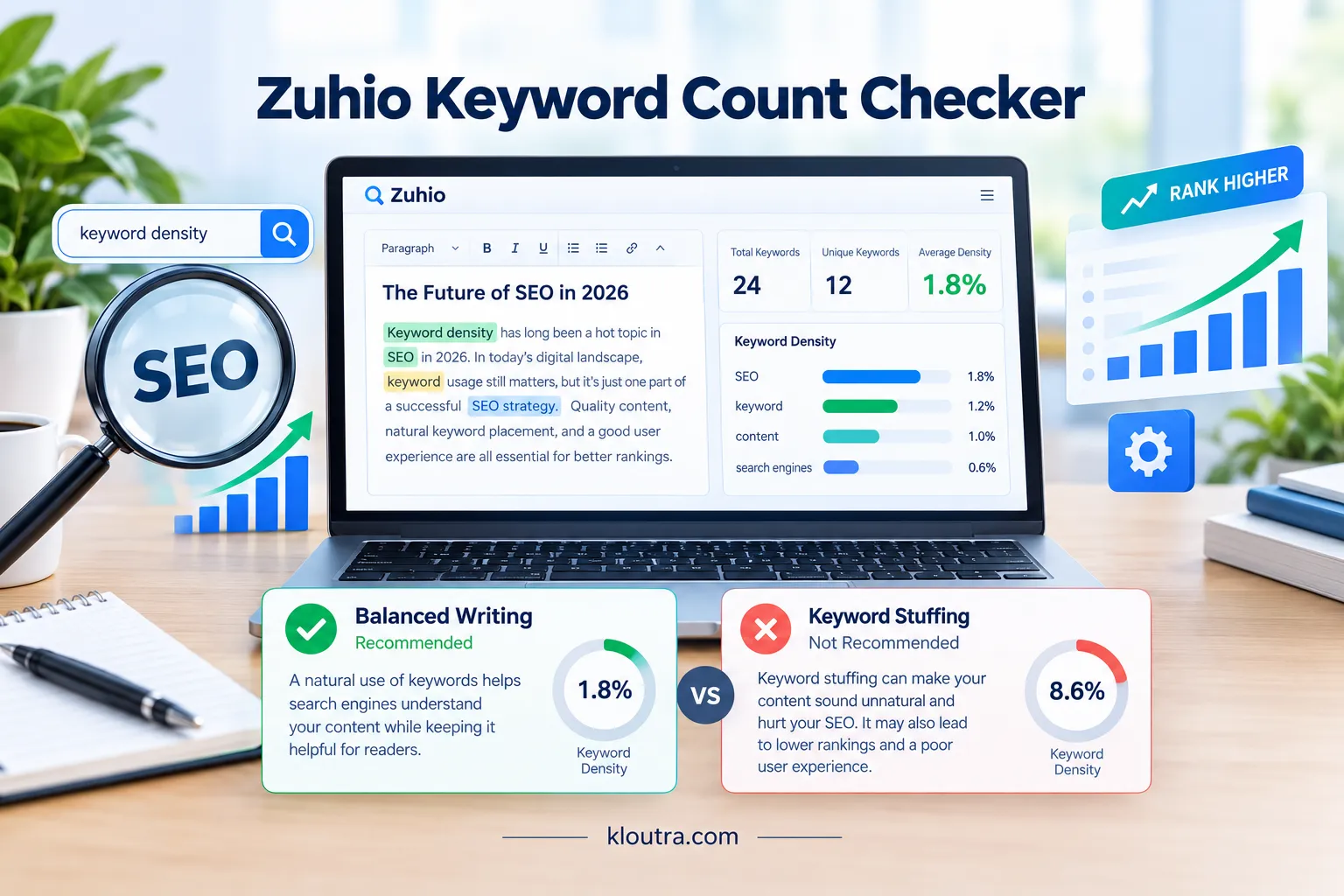
Zuhio Keyword Count Checker: Complete Guide to Features
Introduction
The Zuhio Keyword Count Checker can help you understand how often a keyword appears in your content. For bloggers, website owners, and SEO writers, checking keyword usage is a simple step toward better content optimization. However, counting keywords alone does not guarantee higher search engine rankings.
You also need to consider search intent, readability, keyword placement, and overall content quality. In this guide, you will learn how the tool works, explore its potential features, and discover how to check keyword frequency effectively. We will also cover common mistakes, accuracy considerations, and comparisons with other SEO tools to help you make informed decisions in 2026.
What Is Zuhio Keyword Count Checker?
The Zuhio Keyword Count Checker is designed to help users examine how often a word or phrase appears in a piece of content. A keyword frequency checker can help writers review a draft without counting each mention manually. Depending on the tool’s current functions, it may also show the keyword’s share of the text. This makes it useful during editing, especially when an article targets a specific search query.
A keyword counter is different from a complete SEO analysis tool. It does not automatically tell you whether an article answers the reader’s question or deserves a high ranking. Nor should you assume it offers keyword research, backlink checks, or technical site reports. Think of it as one small part of your SEO content optimization process. Use it to review wording, then assess the article’s value, accuracy, and relevance separately.
How Does a Keyword Count Tool Work?
A typical keyword count tool takes a text sample and a word or phrase to track. It then counts matching occurrences according to its own counting rules. Some tools may also calculate the phrase’s percentage of the total text. The exact method matters because punctuation, capitalization, and phrase matching can affect results. Check the tool’s instructions before comparing its numbers with another checker.
For example, imagine your article contains the phrase “keyword research” eight times. A counter may report eight occurrences if it treats every matching phrase as a separate mention. However, a tool that handles word variations differently could produce another result. This is why keyword frequency analysis works best when you understand what the tool measures. It can reveal repetition, but it cannot judge whether every mention adds value.
Why Keyword Count and Density Matter in SEO
Keyword usage helps search engines understand a page’s subject, but repetition alone does not make content useful. Search engine optimization involves creating helpful content, organizing information, and making pages easier to discover. A sensible keyword optimization process starts with the reader’s needs. It then uses relevant terms where they fit naturally. Google’s SEO Starter Guide recommends clear, useful content rather than tricks designed to manipulate rankings.
Consider an article about choosing project management software. Repeating “project management software” in every paragraph would sound awkward. Instead, the writer could discuss team collaboration, task tracking, deadlines, and reporting. These semantic keywords help explain the topic in greater detail. Strong content relevance comes from answering the reader’s questions, not reaching a fixed density target. A useful keyword placement strategy supports clarity while keeping the article easy to read.
Keyword Count vs. Keyword Density
Keyword count measures how many times a term appears. Density expresses those occurrences as a percentage of the text. For example, a 1,000-word article with ten occurrences has a 1% occurrence-based density. This calculation offers a quick reference, but it does not tell you whether those mentions appear in useful places. The keyword density percentage should support your editing decisions rather than control them.
Does Keyword Density Affect Google Rankings?
There is no universal keyword density percentage that guarantees better rankings. Google’s spam policies identify unnatural keyword repetition as keyword stuffing, which can violate its rules. The official spam policies explain that excessive repetition can harm search visibility.
Key Features of Zuhio Keyword Count Checker
The main purpose of the Zuhio Keyword Count Checker is to help users review keyword usage. Its practical value depends on the features available on the official tool page. A content analysis tool may show the number of matching phrases, the text length, or a density percentage. Verify which results Zuhio actually provides before describing them as confirmed features. This simple check keeps your article accurate and useful.
A keyword counter can support keyword distribution reviews by helping you notice repeated phrases in a draft. However, a basic counter may not show where every occurrence appears or whether a paragraph answers the reader’s question. It also should not replace a full content audit. Review your headings, facts, examples, and explanations alongside the numbers. That combination gives you a clearer picture of the article’s strengths and weaknesses.
Keyword Frequency and Density Analysis
Keyword frequency refers to how often a selected word or phrase appears in a text. A checker can help you spot frequent repetitions that are easy to miss during editing. Some tools also calculate density, but their counting methods may differ. Before trusting a result, check whether the tool counts exact phrases, partial matches, or variations.
Content Length and Keyword Distribution
A word count checker helps you understand the size of your draft. Longer articles may contain more keyword occurrences without having a higher density. For instance, ten mentions in 1,000 words produce a different percentage from ten mentions in 2,000 words. Still, article length should reflect the subject. Adding unnecessary paragraphs just to increase word count rarely improves the reader’s experience.
Free Access and Tool Limitations
Before using Zuhio, verify whether it remains free and whether it requires an account. Check any usage limits, supported text formats, and privacy terms as well. These details matter if you work with client drafts or unpublished business content. A reliable workflow should consider the tool’s actual capabilities rather than assuming it offers advanced reporting, keyword suggestions, or competitor data.
How to Use Zuhio Keyword Count Checker
Using the Zuhio Keyword Count Checker should begin with a clear goal. Decide which phrase you want to review and why it matters to the article. Then prepare the draft you intend to publish. If the tool provides a text box, enter your content and target phrase according to its instructions. Review the results before making changes. The aim is to find problems, not to chase a perfect number.
Next, read the article from the visitor’s point of view. Does the introduction explain the topic? Do the headings answer important questions? Does each keyword mention sound natural? Good SEO content writing balances search relevance with clear explanations. Use the checker as one step in a wider content optimization checklist that also covers factual accuracy, structure, readability, and useful examples.
A Simple Four-Step Workflow
First, open the tool and prepare a clean copy of your draft. Second, enter your target keyword exactly as you intend to track it. Third, review the returned count and any density result the tool provides. Finally, edit awkward repetition and check the article again. Because tools can use different counting rules, test a short sample manually when accuracy matters.
How to Interpret Keyword Count Results
The numbers from a checker become useful when you understand their limits. Keyword analysis results can show that a phrase appears repeatedly, but they cannot tell you whether those mentions improve the article. A low count may be perfectly reasonable when the subject is clear. A high count may also make sense in a detailed tutorial that must refer to a specific tool. Context matters more than an arbitrary target.
Use the results to find patterns that deserve a closer look. If the same phrase appears in nearly every sentence, revise the writing where repetition feels forced. If the term appears only once, check whether the article still explains the subject clearly. Your content readability should remain a priority throughout this process. The best edit often replaces repeated wording with a clearer explanation instead of adding another exact-match phrase.
How to Calculate Keyword Density
You can calculate density with a simple formula:
Keyword density (%) = (Keyword occurrences ÷ Total word count) × 100
For example, ten occurrences divided by 1,000 words equals 1%. This is an arithmetic example, not an SEO recommendation. Different tools may count phrases, punctuation, or matching variations differently, so compare results only when you understand the method.
Is There an Ideal Keyword Density?
No single percentage works for every page. A short definition and a long technical guide naturally use language differently. Treat density as a diagnostic measure, not a required score. Review the article’s purpose, natural wording, and coverage of the subject before deciding whether any changes are necessary.
How to Improve Keyword Placement
Use your main phrase where it helps readers understand the page, including the title and opening section when appropriate. Add it to headings only when it fits the section. A sensible title tag optimization approach creates a clear, accurate title rather than a string of keywords. Likewise, a logical heading structure makes the article easier to scan and navigate.
Common Keyword Density Mistakes
One common mistake is repeating a phrase until the article sounds unnatural. This practice can damage content quality and make the page frustrating to read. Google’s spam policies explain why excessive repetition can count as keyword stuffing. Effective keyword stuffing prevention starts with writing naturally. After drafting, remove phrases that add no meaning and replace them with clear explanations.
Another mistake is ignoring the reader’s purpose. Strong search intent analysis helps you decide which questions an article must answer. For example, someone searching for a keyword checker likely wants to understand its features and use it correctly. They may not need a long explanation of unrelated SEO topics. Review your draft for semantic relevance, useful examples, and natural transitions. Each paragraph should help the reader learn something or complete a task.
Avoid Exact-Match Overuse
You don’t need to repeat the exact phrase in every section. Use natural alternatives when they preserve the meaning. Related search terms can help you explain connected ideas without making the article repetitive. However, don’t add every suggested phrase simply to increase keyword coverage. Choose wording that fits the sentence and answers the reader’s question.
Don’t Ignore Readability
A readability score can help identify writing that may be difficult to follow, although no single score captures every reader’s needs. Keep sentences clear, explain technical terms, and use examples when needed. Natural language processing helps computers analyze human language, but you don’t need to write unnaturally for machines. Focus on useful information and let the topic guide your wording.
Is Zuhio Accurate and Reliable?
The Zuhio Keyword Count Checker can be useful for basic text checks if its counting method produces consistent results. However, I can’t confirm its current accuracy without testing the live tool against known text samples. A dependable review should compare its results with a manual count and check how it handles punctuation, capitalization, and multi-word phrases. Mathematical accuracy and SEO usefulness are two different things.
The same distinction applies to the wider Google ranking algorithm. A keyword counter cannot predict how Google will rank an article. It cannot independently measure expertise, assess every aspect of search intent, or confirm that the page answers the reader’s question. Use the checker for the task it supports, then review your article and website separately. That approach gives you a more realistic view of your SEO performance.
How to Test Counting Accuracy
Create a short sample containing a known number of keyword mentions. Include different capitalization styles and punctuation if you want to test how the tool handles them. Compare the displayed result with your manual count. Repeat the test with a multi-word phrase. If the results differ, investigate the counting rules before using the tool for important editorial decisions.
What the Tool Cannot Measure
A keyword count cannot replace a Technical SEO audit, which examines issues such as crawling, indexing, and technical accessibility. Nor can it provide meaningful Backlink analysis unless it offers separate, verified link-analysis features. The same applies to Competitor analysis and search-volume research. Those tasks require other data and methods. Don’t treat one simple metric as a complete assessment of a website.
Zuhio vs. Other SEO Tools
A useful SEO tool comparison starts with the job you need to complete. A basic checker focuses on keyword counts, while broader platforms may support keyword research, content planning, or website analysis. For example, Ahrefs, Semrush, and Surfer offer wider SEO or content workflows. Their exact features and pricing can change, so check their official product pages before choosing a plan.
The Zuhio Keyword Count Checker may suit a writer who needs a quick frequency check. A broader platform may be more appropriate when you need search-volume estimates, competitor research, or technical reports. Neither option replaces sound judgment. Choose a tool based on your budget, workload, and required features. The best setup is the one that answers your questions without adding unnecessary complexity to your process.
| Tool type | Main purpose | Best use |
|---|---|---|
| Keyword count checker | Counts selected words or phrases | Reviewing repetition |
| Word counter | Measures text length | Checking article length |
| SEO research platform | Supports keyword and competitor research | Planning content topics |
| Technical SEO tool | Identifies website-level issues | Auditing site health |
| Content optimization tool | Helps review content against selected criteria | Editing and content planning |
Which Tool Should You Choose?
If you only need to count a phrase, a basic checker may be enough. If you’re planning a content campaign, a broader platform may provide more useful information. Consider the tasks you perform most often and compare the cost with the time saved. Before paying for any service, confirm that it includes the features your workflow actually requires.
Benefits and Limitations of Zuhio
A simple keyword counter can save time during editing. It helps writers notice repetition and review a target phrase without counting every mention manually. It may also support a final review before publication. These benefits are practical rather than transformative. The tool cannot make weak content useful or guarantee higher Search engine rankings. Its value depends on how well you use the information it provides.
There are also clear limits. A frequency count does not establish whether a page is accurate, original, or helpful. It cannot replace editorial judgment or broader research. Use the tool alongside other SEO writing tools when your project requires additional checks. A balanced workflow combines keyword review with factual verification, clear organization, and useful answers. That is more reliable than relying on a single score.
Benefits for Writers and Website Owners
Bloggers can use keyword counts to review drafts before publishing. Freelance writers can check whether a client brief’s target phrase appears naturally. Small business owners can use a similar process when reviewing service pages or articles. If you also want to attract nearby customers, these local SEO tips can help you improve your visibility in your area. For each audience, the goal remains the same: identify unnecessary repetition while keeping the message clear.
Limitations to Consider
Before submitting unpublished material, review the tool’s privacy policy and data-handling terms. Don’t assume a browser-based service keeps every draft private simply because it requires no installation. Also verify whether it stores submitted text. These checks matter when you work with confidential client information, original research, or unreleased business content.
Who Should Use Zuhio Keyword Count Checker?
The Zuhio Keyword Count Checker may help bloggers, freelance writers, small business owners, and affiliate marketers who need a quick keyword review. Beginners can use a counter to understand how often a phrase appears. Experienced writers can use it as a final editing check. However, the right choice depends on the tool’s verified features and the needs of each project.
SEO professionals and content teams may also find a basic counter useful for small tasks. It should remain one part of a wider editorial process. Teams working on larger websites often need research platforms, analytics, and technical checks as well. Search engine optimization involves several connected activities, so no single tool can handle every task. Choose a workflow that supports your goals without making simple jobs harder than necessary.
Best Fit for Different Users
| User | How a keyword counter can help |
|---|---|
| Blogger | Review repetition before publishing |
| Freelance writer | Check keyword use against a writing brief |
| Small business owner | Review website copy |
| Affiliate marketer | Check product-related content |
| SEO specialist | Add a quick check to an editing workflow |
| Content team | Standardize one part of the final review |
Conclusion
The Zuhio Keyword Count Checker can serve as a practical part of your editing process when you need to review keyword frequency. It helps you examine repetition and understand how often a target phrase appears. However, the results should guide your decisions rather than dictate them. Verify the tool’s current features and counting method before relying on its output.
For better content, focus on the reader first. Answer the search query, use clear headings, support important claims, and remove unnecessary repetition. Combine keyword checks with relevant research and careful editing. A keyword counter can help you spot a problem, but useful content and sound SEO practices require much more than a percentage.
Frequently Asked Questions
Is the Zuhio Keyword Count Checker free?
Check the official tool page for current pricing and access requirements. Don’t assume the tool remains free or has unlimited use without confirming those details.
What is a good keyword density percentage?
There is no universal percentage that guarantees better rankings. Use density as an editing signal and prioritize natural language, relevance, and useful information.
Can keyword density improve Google rankings?
Keyword use can help communicate a page’s subject, but repeating a phrase does not guarantee better rankings. Google warns against excessive repetition intended to manipulate search results.
Can I check long-tail keywords?
That depends on the tool’s phrase-matching functionality. Verify whether it accepts multi-word phrases and how it counts exact matches before using it for a long-tail keyword review.
Does Zuhio replace a complete SEO platform?
No single keyword-counting feature can replace every SEO task. Keyword research, technical checks, link analysis, and performance reporting require other methods or tools when those features aren’t provided.
What should I check before publishing an article?
Review keyword repetition, factual accuracy, search intent, headings, and readability. Make sure the article answers the reader’s question and that every section adds useful information.
Disclaimer: This guide provides general information about the Zuhio Keyword Count Checker. Tool features and accuracy may change. Keyword counts alone do not guarantee better SEO rankings.